Complete Project Cycle Explained: All Project Phases from Initiation to Closure
-
January 27, 2026
Successful projects don’t happen by chance—they follow a structured approach known as the Project Cycle (or Project Life Cycle). This framework guides a project from idea to completion, ensuring objectives are met within scope, time, cost, and quality constraints.
In this blog, we explain the complete project cycle, breaking down each phase with detailed steps, purpose, and key outputs, aligned with industry best practices and PMP® standards.
🔁 Complete Project Cycle (All Phases with Detailed Steps)
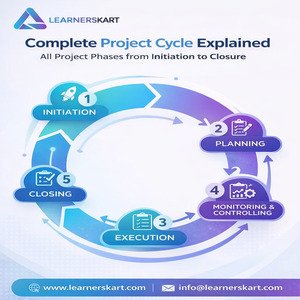
Initiation → Planning → Execution → Monitoring amp; Controlling → Closing
1️⃣ Project Initiation
Purpose
Define the project at a high level and obtain formal approval to begin.
Key Steps
Estimate Project Size
-
Rough estimation of effort, duration, and cost
-
High-level feasibility assessment
Prepare Project Proposal
-
Business justification
-
Expected benefits and objectives
-
High-level risks and constraints
Review amp; Approve Proposal
-
Evaluation by sponsor or steering committee
-
Decision to proceed or reject
Prepare Project Charter
-
Project objectives and success criteria
-
High-level scope and deliverables
-
Budget summary and key milestones
-
Appointment of the Project Manager
Conduct Kickoff Meeting
-
Introduce key stakeholders
-
Communicate project objectives and expectations
-
Align roles and responsibilities
📌 Key Output:
✅ Approved Project Charter
2️⃣ Project Planning
Purpose
Define how the project will be executed, monitored, and controlled.
Key Steps
Assess amp; Approve Detailed Plan
-
Detailed scope definition
-
Project schedule and milestones
-
Cost estimates and finalized budget
Develop Detailed Project Plans
-
Scope baseline (WBS)
-
Schedule baseline
-
Cost baseline
-
Quality management plan
-
Risk management plan
-
Communication plan
-
Procurement plan
Revise Project Charter (If Required)
-
Applicable for long-duration projects
-
Updates to scope, cost, or timeline with approval
Conduct Planning Kickoff Meeting
-
Align the team on the execution strategy
-
Confirm baselines and control mechanisms
📌 Key Output:
✅ Approved Project Management Plan
3️⃣ Project Execution
Purpose
Perform the work defined in the project plan and produce deliverables.
Key Steps
Execute Planned Activities
-
Develop and deliver project outputs
-
Manage teams and resources
-
Perform quality assurance activities
Manage Stakeholder Engagement
-
Continuous communication
-
Expectation management
-
Issue and conflict resolution
Maintain Risk Register
-
Implement risk response actions
-
Identify and document new risks
Collect Performance Data
-
Track work progress
-
Capture cost and schedule data
📌 Key Output:
✅ Project Deliverables
4️⃣ Monitoring amp; Controlling
Purpose
Track project performance and manage changes while execution is ongoing.
🔄 This phase runs parallel to the Execution phase.
Key Steps
Track amp; Measure Performance
-
Monitor scope, schedule, cost, and quality
-
Use KPIs and Earned Value Management (EVM)
Assess Change Requests
-
Analyze the impact on scope, time, cost, and risk
Approve / Reject Change Requests
-
Decisions made through the Change Control Board (CCB)
Document Approved Changes
-
Update baselines and project plans
-
Maintain the change log
Take Corrective amp; Preventive Actions
-
Address variances
-
Mitigate risks proactively
📌 Key Output:
✅ Performance reports and approved changes
5️⃣ Project Closing
Purpose
Formally complete the project and hand over deliverables.
Key Steps
Verify amp; Accept Deliverables
-
Customer or sponsor sign-off
-
Confirmation that requirements are met
Complete Final Report
-
Performance summary
-
Budget and schedule results
Close Contracts amp; Procurements
-
Vendor payments
-
Contract closure documentation
Document Lessons Learned
-
What worked well
-
What can be improved in future projects
Close Project
-
Release project resources
-
Archive project documents
📌 Key Output:
✅ Official Project Closure
📊 Project Cycle – One-Line Flow
Initiation → Planning → Execution → Monitoring amp; Controlling → Closing
✅ Final Note
Understanding and applying the complete project cycle helps organizations deliver projects more predictably, reduce risks, and maximize value. Whether you are a project manager, PMP® aspirant, PMO professional, or business leader, mastering these phases is essential for project success.
Learnerskart provides expert-led training, practical learning resources, and exam-focused guidance designed for working professionals and PMP® aspirants worldwide.
📞 Contact Learnerskart
🌐 Visit: learnerskart.com | #x1f4e7; Email: info@learnerskart.com
✔️ Follow us for PM tips amp; career insights: https://lnkd.in/gYB4Dw4K
Explore professional certification programs, including PMP®, CAPM®, PMI-ACP®, Lean Six Sigma, PRINCE2®, ITIL®, and more, and take the next step in your project management journey.
Tags:
You May Also Like
-
Mar 26, 2026
📌 Introduction Over the past three decades, project management has evolved from a niche skill into a globally recognized profession....
-
Mar 20, 2026
Introduction In today’s competitive and fast-paced business environment, delivering projects successfully is more challenging than ever. Many projects fail—not due...
-
Mar 18, 2026
Most PMP aspirants believe success comes from memorizing the PMBOK® Guide and solving hundreds of questions. But here’s the truth:...
-
Mar 17, 2026
In many organisations, the role of a Project Manager is often misunderstood. Some people believe that a great Project Manager...
Sign up to receive our latest updates
Company
Support
Service Offerings
Special Offers
Get in touch
India
Call us directly?
+91-984-459-1589
Address
Learnerskart Solutions Pvt Ltd
4th floor, No: 207/189, 9th Main Rd, 6th Sector,
HSR Layout, Bengaluru, Karnataka 560102
info@learnerskart.com
USA
Call us directly?
+1 (307)-998-3816
Address
Learnerskart Americas LLC
30 N Gould St Ste R
Sheridan, WY 82801
info@learnerskart.com
Quick Contact
Trending Categories
Disclaimer
“PMI®”, “PMBOK®”, “PMP®”, “CAPM®” and “PMI-ACP®” are registered marks of the Project Management Institute, Inc.
ITIL® and PRINCE2® are registered trade marks of AXELOS Limited, used under permission of AXELOS Limited. All rights reserved.
“CSM”, “CST” are Registered Trade Marks of The Scrum Alliance, USA.
