
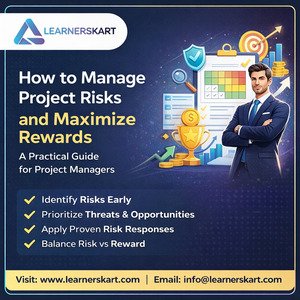
How to Manage Project Risks and Maximize Rewards: A Practical Guide for Project Managers
-
January 21, 2026
Projects rarely fail because of a lack of ideas or effort. Most fail because risks are not identified, analyzed, or managed proactively. In today’s fast-paced, uncertain business environment, successful project managers don’t avoid risk—they manage it strategically to maximize rewards.
This practical guide explains how to manage project risks effectively, transform uncertainty into opportunity, and deliver higher value to stakeholders.
What Is Project Risk Management?
Project Risk Management is the systematic process of identifying, analyzing, prioritizing, and responding to risks throughout the project lifecycle.
According to PMBOK®, a project risk is an uncertain event or condition that, if it occurs, has a positive or negative impact on project objectives such as scope, schedule, cost, or quality.
👉 Risks are not always threats—they can also be opportunities.
Why Risk Management Is Critical for Project Success
Effective risk management helps project managers:
-
Reduce unexpected delays and cost overruns
-
Improve decision-making under uncertainty
-
Increase stakeholder confidence and trust
-
Protect business value and benefits realization
-
Turn risks into competitive advantages
Key Insight:
High-performing project managers don’t eliminate risk—they control and leverage it.
Step 1: Identify Risks Early and Continuously
Risk identification should begin during project initiation and continue throughout execution.
Common Risk Categories
-
Strategic Risks – changing business priorities, market shifts
-
Operational Risks – resource shortages, process failures
-
Technical Risks – new technology, integration issues
-
Schedule Risks – unrealistic timelines, dependency delays
-
Cost Risks – budget overruns, inaccurate estimates
-
External Risks – regulatory changes, vendor issues
Practical Techniques
-
Brainstorming sessions
-
Expert judgment
-
SWOT analysis
-
Lessons learned from past projects
-
Risk checklists
📌 Tip: Involve the entire project team and stakeholders to uncover hidden risks.
Step 2: Analyze and Prioritize Risks
Not all risks deserve equal attention. Focus on the ones that matter most.
Qualitative Risk Analysis
Evaluate risks based on:
-
Probability (likelihood of occurrence)
-
Impact (effect on objectives)
Use a Probability–Impact Matrix to rank risks as high, medium, or low.
Quantitative Risk Analysis (Advanced)
-
Monte Carlo simulation
-
Sensitivity analysis
-
Expected Monetary Value (EMV)
📌 Focus your energy on high-impact, high-probability risks.
Step 3: Plan Effective Risk Responses
Once risks are prioritized, define clear response strategies.
Risk Response Strategies for Threats
-
Avoid – eliminate the risk entirely
-
Mitigate – reduce probability or impact
-
Transfer – shift responsibility (insurance, contracts)
-
Accept – acknowledge and monitor
Risk Response Strategies for Opportunities
-
Exploit – ensure the opportunity occurs
-
Enhance – increase probability or impact
-
Share – partner with others
-
Accept – take advantage if it happens
💡 Smart PMs don’t just reduce losses—they maximize gains.
Step 4: Create and Maintain a Risk Register
A Risk Register is the backbone of project risk management.
Typical Risk Register Fields
-
Risk ID
-
Risk Description
-
Category
-
Probability
-
Impact
-
Risk Score
-
Owner
-
Response Strategy
-
Status
📌 Review and update the risk register during status meetings.
Step 5: Monitor Risks Throughout the Project
Risk management is not a one-time activity.
Best Practices
-
Track triggers and early warning signs
-
Conduct regular risk reviews
-
Update response plans
-
Escalate critical risks early
-
Close risks that are no longer relevant
🎯 Proactive monitoring prevents surprises and protects project value.
Step 6: Balance Risk and Reward in Decision-Making
Every project decision involves trade-offs.
Ask These Questions:
-
What is the potential reward?
-
What is the downside if it fails?
-
Is the risk aligned with business goals?
-
Can we control or influence the outcome?
📌 Calculated risk-taking often leads to innovation, faster delivery, and competitive advantage.
Common Mistakes Project Managers Make with Risks
Avoid these pitfalls:
-
Treating risk management as documentation only
-
Ignoring positive risks (opportunities)
-
Not assigning risk owners
-
Waiting too long to respond
-
Failing to communicate risks to stakeholders
🚫 Risk ignored today becomes a crisis tomorrow.
How PMP®-Certified Project Managers Excel at Risk Management
PMP-certified professionals are trained to:
-
Apply structured risk frameworks
-
Use data-driven analysis
-
Align risks with business strategy
-
Communicate risk effectively
📈 Organizations value PMPs because they protect investments while maximizing outcomes.
Final Thoughts
Risk is unavoidable—but failure is not.
By identifying risks early, prioritizing wisely, planning effective responses, and continuously monitoring uncertainty, project managers can reduce threats and unlock new opportunities.
Successful projects aren’t risk-free. They’re risk-ready.
Want to Master Project Risk Management?
Learn industry-proven risk management techniques and PMP® exam-aligned practices with Learnerskart.
🌐 Visit: learnerskart.com | #x1f4e7; Email: info@learnerskart.com
✔️ Follow us for more project management tips amp; career insights! https://lnkd.in/gYB4Dw4K
Tags:
You May Also Like

-
Mar 31, 2026
Introduction The role of a Senior Project Manager is evolving faster than ever. With increasing complexity, tighter deadlines, and higher...
-
Mar 30, 2026
Understanding the Real Power (and Limits) of Project Management Project managers are often seen as problem solvers who can “fix...
-
Mar 26, 2026
📌 Introduction Over the past three decades, project management has evolved from a niche skill into a globally recognized profession....
-
Mar 20, 2026
Introduction In today’s competitive and fast-paced business environment, delivering projects successfully is more challenging than ever. Many projects fail—not due...
Sign up to receive our latest updates
Company
Support
Service Offerings
Special Offers
Get in touch
India
Call us directly?
+91-984-459-1589
Address
Learnerskart Solutions Pvt Ltd
4th floor, No: 207/189, 9th Main Rd, 6th Sector,
HSR Layout, Bengaluru, Karnataka 560102
info@learnerskart.com
USA
Call us directly?
+1 (307)-998-3816
Address
Learnerskart Americas LLC
30 N Gould St Ste R
Sheridan, WY 82801
info@learnerskart.com
Quick Contact
Trending Categories
Disclaimer
“PMI®”, “PMBOK®”, “PMP®”, “CAPM®” and “PMI-ACP®” are registered marks of the Project Management Institute, Inc.
ITIL® and PRINCE2® are registered trade marks of AXELOS Limited, used under permission of AXELOS Limited. All rights reserved.
“CSM”, “CST” are Registered Trade Marks of The Scrum Alliance, USA.
