PMBOK 7 vs PMBOK 8 Comparison: What’s New in the Latest PMI Guide | Learnerskart
-
November 25, 2025
The Project Management Body of Knowledge (PMBOK® Guide) continues to evolve as the profession advances. With the release of PMBOK 8, PMI has introduced a more structured, practical, and process-aligned guide—bringing back many elements professionals loved while keeping the modern, principle-driven philosophy of PMBOK 7.
If you’re preparing for the PMP exam, managing projects, or updating your organizational standards, understanding the key differences between PMBOK 7 and PMBOK 8 is essential.
🌟 Why the Shift From PMBOK 7 to PMBOK 8?
PMBOK 7 focused on principles, performance domains, and value delivery. However, many practitioners and organizations wanted:
-
More processes
-
Clearer guidance
-
Actionable steps
-
Stronger alignment with PMP exam content
-
Better integration of agile, hybrid, and predictive models
PMBOK 8 is PMI’s answer—bringing back structure without losing modern flexibility.
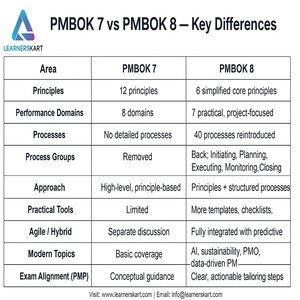
🔍 PMBOK 7 vs PMBOK 8: Key Differences (Simplified)
| Area | PMBOK 7 | PMBOK 8 |
|---|---|---|
| Principles | 12 principles | 6 simpler, refined principles |
| Performance Domains | 8 domains | 7 practical domains |
| Processes | No detailed processes | 40 processes reintroduced |
| Process Groups | Removed | Back: Initiating → Planning → Executing → Monitoring → Closing |
| Approach | High-level, principle-based | Principles + structured process-based approach |
| Templates amp; Tools | Limited | Expanded tools, checklists, templates |
| Agile / Hybrid | Discussed separately | Fully integrated with predictive models |
| Modern Topics | High-level mention | AI, sustainability, PMO maturity, data-driven PM |
| PMP Exam Alignment | Indirect link | Strong alignment with EPC (People–Process–Business) |
| Tailoring Guidance | Conceptual | Step-by-step practical tailoring |
📘 1. Principles: From 12 → 6 Core Principles
PMBOK 7 introduced 12 broad principles.
PMBOK 8 simplifies these into 6 core, universal principles, making the guide easier to understand and apply across industries.
This supports faster training, clearer onboarding, and simpler organizational alignment.
📘 2. Domains: From 8 → 7 Performance Domains
PMBOK 7 defined 8 performance domains such as stakeholder management, team, and planning.
PMBOK 8 reorganizes this into 7 practical domains, aligning closely with real-world project delivery and modern expectations.
The domains now support actionable planning, execution, and governance.
📘 3. Processes Return: The Biggest Change in PMBOK 8
One of the major criticisms of PMBOK 7 was the removal of detailed processes.
PMBOK 8 brings back:
-
~40 standard processes
-
Clear inputs, tools, and outputs
-
Predictive, agile, and hybrid integration
-
Real-world examples
This aligns the guide much more closely with how organizations actually execute projects.
📘 4. Process Groups Reintroduced
After disappearing in PMBOK 7, process groups are back:
-
Initiating
-
Planning
-
Executing
-
Monitoring amp; Controlling
-
Closing
This ensures consistency with earlier editions and industry standards.
📘 5. Better Integration of Agile + Hybrid
While PMBOK 7 discussed agile and hybrid separately, PMBOK 8 fully integrates them into processes, tools, tailoring, and delivery models.
This helps project managers understand:
-
When to use agile
-
When hybrid is better
-
How predictive and agile coexist in real projects
📘 6. Modern Topics Added in PMBOK 8
PMBOK 8 includes new and updated topics:
-
AI in project management
-
Sustainability amp; ESG-focused delivery
-
Data-driven decision-making
-
Project Management Office (PMO) evolution
-
Business agility
-
Digital transformation impacts
These align the guide with current global trends.
📘 7. Tailoring: More Actionable and Practical
PMBOK 7 discussed tailoring as a concept.
PMBOK 8 gives:
-
Step-by-step tailoring approach
-
Tailoring considerations for agile, hybrid, and predictive
-
Tools and templates that support tailoring
-
Role-based tailoring guidance
This helps project managers adapt processes based on project size, industry, and complexity.
📘 8. Stronger Alignment With the PMP Exam
The PMP exam content outline (ECO) focuses on:
-
People
-
Process
-
Business Environment
PMBOK 8 aligns more closely with this structure, ensuring professionals preparing for the PMP exam have more clarity and consistency.
📝 Conclusion: PMBOK 8 Brings Structure + Modern Relevance
PMBOK 8 is essentially a balanced evolution—combining the clarity of earlier editions with the modern thinking of PMBOK 7. It offers:
-
More structure
-
Clear processes
-
Better examples
-
Stronger exam alignment
-
Practical guidance for today’s dynamic, tech-driven environment
If you’re preparing for PMP or managing complex projects, PMBOK 8 gives you the tools you need to stay relevant and effective.
📣 Want to Master PMBOK 8 and Clear PMP on the First Attempt?
LearnersKart offers globally trusted PMP training with:
✔ 95% success rate
✔ Updated PMBOK 8–aligned content
✔ 2000+ practice questions
✔ Mock exams amp; exam strategy
✔ Instructor-led classes
🌐 Visit: learnerskart.com | #x1f4e7; Email: info@learnerskart.com
✔️ Follow us for more project management tips amp; career insights! https://lnkd.in/gYB4Dw4K
Tags:
You May Also Like
-
Mar 20, 2026
Introduction In today’s competitive and fast-paced business environment, delivering projects successfully is more challenging than ever. Many projects fail—not due...
-
Mar 18, 2026
Most PMP aspirants believe success comes from memorizing the PMBOK® Guide and solving hundreds of questions. But here’s the truth:...
-
Mar 17, 2026
In many organisations, the role of a Project Manager is often misunderstood. Some people believe that a great Project Manager...
-
Mar 9, 2026
The Project Management Institute (PMI) has announced a major update to the Project Management Professional (PMP®) certification exam, effective March...
Sign up to receive our latest updates
Company
Support
Service Offerings
Special Offers
Get in touch
India
Call us directly?
+91-984-459-1589
Address
Learnerskart Solutions Pvt Ltd
4th floor, No: 207/189, 9th Main Rd, 6th Sector,
HSR Layout, Bengaluru, Karnataka 560102
info@learnerskart.com
USA
Call us directly?
+1 (307)-998-3816
Address
Learnerskart Americas LLC
30 N Gould St Ste R
Sheridan, WY 82801
info@learnerskart.com
Quick Contact
Trending Categories
Disclaimer
“PMI®”, “PMBOK®”, “PMP®”, “CAPM®” and “PMI-ACP®” are registered marks of the Project Management Institute, Inc.
ITIL® and PRINCE2® are registered trade marks of AXELOS Limited, used under permission of AXELOS Limited. All rights reserved.
“CSM”, “CST” are Registered Trade Marks of The Scrum Alliance, USA.
