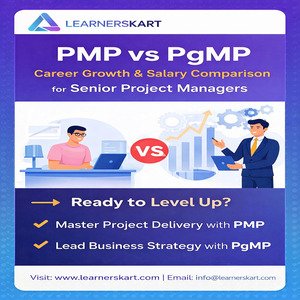
PMP vs PgMP: Career Growth & Salary Comparison for Senior Project Managers
-
March 4, 2026
If you’re an experienced Project Manager, there comes a point in your career when you ask:
“What’s next after PMP?”
Is it time to stay focused on large, complex projects — or move toward managing multiple strategic initiatives at an enterprise level?
That’s where the comparison between the Project Management Institute’s Project Management Professional (PMP) and Program Management Professional (PgMP) becomes important.
This guide will help senior project managers understand:
-
The real difference between PMP and PgMP
-
Career growth opportunities
-
Salary comparison
-
Industry demand
-
When it makes sense to upgrade
-
Who should choose what
Let’s break it down in simple, practical terms.
1️⃣ Understanding the Core Difference
🔹 PMP – Project-Level Leadership
PMP validates your ability to:
-
Lead a single project from start to finish
-
Manage scope, schedule, cost, risk, and stakeholders
-
Deliver defined outputs within constraints
-
Lead cross-functional teams
You are responsible for execution and delivery.
Even if the project is large and complex, your focus remains on one project at a time.
🔹 PgMP – Enterprise-Level Strategy
PgMP validates your ability to:
-
Manage multiple related projects (a program)
-
Align projects with business strategy
-
Deliver long-term business benefits
-
Influence executives and senior stakeholders
-
Handle governance at organizational level
You are responsible for business outcomes, not just project outputs.
This is a strategic leadership role.
2️⃣ Role Comparison: Project Manager vs Program Manager
| Area | PMP (Project Manager) | PgMP (Program Manager) |
|---|---|---|
| Focus | Deliver project outputs | Deliver business benefits |
| Scope | Single project | Multiple related projects |
| Reporting | Sponsors / Business heads | Executive leadership |
| Risk Impact | Project-level risk | Organizational-level risk |
| Strategy Involvement | Limited to project | High strategic involvement |
In simple terms:
👉 Project Managers deliver projects.
👉 Program Managers drive business transformation.
3️⃣ Career Growth Comparison
🚀 After PMP
With PMP, you can grow into:
-
Senior Project Manager
-
Portfolio Project Manager
-
Delivery Manager
-
PMO Lead
However, growth March remain within project execution leadership.
🚀 After PgMP
With PgMP, you position yourself for:
-
Program Director
-
Head of PMO
-
Transformation Leader
-
Business Unit Head
-
VP – Programs
PgMP shifts you from operational leadership to strategic enterprise leadership.
If you want a seat at the executive table — PgMP is designed for that path.
4️⃣ Salary Comparison (Global Perspective)
While salaries vary by country and industry, globally:
-
PMP-certified senior project managers earn strong mid-to-senior management salaries.
-
PgMP-certified professionals typically earn higher due to enterprise impact and strategic accountability.
Why PgMP professionals earn more:
-
They manage larger budgets
-
They influence business direction
-
They handle multiple high-risk initiatives
-
Their decisions impact organizational profitability
In many global markets, Program Managers earn 15–25% more than Project Managers at similar experience levels.
5️⃣ Eligibility amp; Difficulty Level
🔹 PMP
-
3–5 years of project management experience
-
Single comprehensive exam
-
Widely pursued certification
🔹 PgMP
-
Extensive program management experience
-
Multi-stage evaluation (panel review + exam)
-
Much more selective
-
Designed for senior professionals (typically 8–12+ years experience)
PgMP is not just an exam — it is a career validation at leadership level.
6️⃣ Industry Demand: What Employers Are Looking For
🌍 High Demand Across Key Sectors
PMP remains one of the most desired credentials for employers across:
-
IT amp; Software
-
Banking amp; Finance
-
Construction amp; Infrastructure
-
Manufacturing
-
Healthcare amp; Pharmaceuticals
-
Government amp; Public Sector
Organizations that run large projects rely on PMP professionals to deliver predictable outcomes.
🚀 Growing Need for Program Leaders
Demand for PgMP professionals is increasing in:
-
Enterprise digital transformation initiatives
-
Multi-project environments
-
PMO and Strategic Execution functions
-
Large global corporations with complex portfolios
-
Organizations focusing on business benefits, not just outputs
Especially in fast-growing economies and multinational enterprises, program leadership is a high-priority role.
7️⃣ When Should a PMP Consider PgMP?
You should consider PgMP if:
✅ You already manage multiple projects simultaneously
✅ You coordinate several project managers
✅ You align projects with business strategy
✅ You influence CXOs or executive leaders
✅ You are targeting Director / VP-level roles
If you’re still focused mainly on delivering one project at a time, PMP March be sufficient.
8️⃣ Which One Is Right for You?
Choose PMP if:
-
You are building or strengthening your project leadership career
-
You want global recognition
-
You manage individual projects
Choose PgMP if:
-
You already hold PMP
-
You manage multiple projects
-
You influence business strategy
-
You aim for executive-level growth
Both certifications are valuable — the key is aligning your certification with your career goals.
Final Thoughts
Both PMP and PgMP are prestigious certifications from PMI.
But they serve different career stages.
PMP proves you can deliver projects successfully.
PgMP proves you can lead strategic programs that transform organizations.
For senior project managers asking, “What’s my next big career move?” — PgMP is often the logical progression.
The real question is not:
“Which is better?”
The real question is:
“Are you ready to move from managing projects to driving enterprise strategy?” #x1f680;
Want Career Guidance or Certification Support?
For personalized guidance, exam assistance, or training for PMP or PgMP, contact Learnerskart — your trusted partner for professional certification success.
🌐 Visit: learnerskart.com | #x1f4e7; Email: info@learnerskart.com
✔️ Follow us for PM tips amp; career insights: https://lnkd.in/gYB4Dw4K
Tags:
You May Also Like
-
Mar 20, 2026
Introduction In today’s competitive and fast-paced business environment, delivering projects successfully is more challenging than ever. Many projects fail—not due...
-
Mar 18, 2026
Most PMP aspirants believe success comes from memorizing the PMBOK® Guide and solving hundreds of questions. But here’s the truth:...
-
Mar 17, 2026
In many organisations, the role of a Project Manager is often misunderstood. Some people believe that a great Project Manager...
-
Mar 9, 2026
The Project Management Institute (PMI) has announced a major update to the Project Management Professional (PMP®) certification exam, effective March...
Sign up to receive our latest updates
Company
Support
Service Offerings
Special Offers
Get in touch
India
Call us directly?
+91-984-459-1589
Address
Learnerskart Solutions Pvt Ltd
4th floor, No: 207/189, 9th Main Rd, 6th Sector,
HSR Layout, Bengaluru, Karnataka 560102
info@learnerskart.com
USA
Call us directly?
+1 (307)-998-3816
Address
Learnerskart Americas LLC
30 N Gould St Ste R
Sheridan, WY 82801
info@learnerskart.com
Quick Contact
Trending Categories
Disclaimer
“PMI®”, “PMBOK®”, “PMP®”, “CAPM®” and “PMI-ACP®” are registered marks of the Project Management Institute, Inc.
ITIL® and PRINCE2® are registered trade marks of AXELOS Limited, used under permission of AXELOS Limited. All rights reserved.
“CSM”, “CST” are Registered Trade Marks of The Scrum Alliance, USA.
