
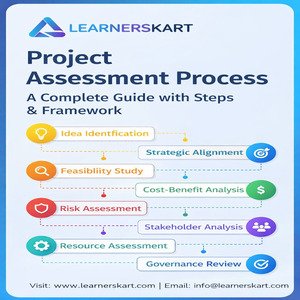
Project Assessment Process: A Complete Guide with Steps & Framework
-
February 23, 2026
In today’s competitive business environment, organisations cannot afford to run projects based on assumptions. Every project requires structured evaluation to ensure it delivers value, meets objectives, and uses resources efficiently.
This is where the Project Assessment Process becomes essential.
A well-defined project assessment framework helps businesses measure effectiveness, control risks, improve performance, and build a culture of continuous improvement. Whether you are managing IT projects, construction initiatives, business transformations, or marketing campaigns, a structured assessment approach ensures better outcomes.
Let’s explore this in detail.
What is Project Assessment?
Project assessment is the systematic evaluation of a project’s feasibility, progress, performance, and impact. It examines whether the project:
-
Achieved its intended objectives
-
Stayed within the approved budget
-
Met planned timelines
-
Utilized resources efficiently
-
Delivered expected benefits
Project assessment is not a one-time activity. It can take place at different stages of the project lifecycle.
Types of Project Assessment
1️⃣ Pre-Project Assessment
Conducted before project initiation to evaluate feasibility, risks, costs, and strategic alignment.
2️⃣ Mid-Project Assessment
Performed during project execution to monitor performance and implement corrective actions.
3️⃣ Post-Project Assessment
Carried out after project completion to measure success, capture lessons learned, and evaluate long-term impact.
Together, these assessments ensure continuous improvement and stronger future performance.
The Key Stages of the Project Assessment Process
A structured project assessment framework typically includes the following stages:
1. Planning and Design
This stage builds the foundation of the assessment process.
Key activities include:
-
Defining clear project objectives
-
Establishing measurable success criteria
-
Identifying Key Performance Indicators (KPIs)
-
Selecting appropriate assessment methodologies
-
Designing a data collection strategy
Without clear planning, assessment results March lack direction and accuracy.
2. Implementation and Monitoring
Once the project is underway, continuous monitoring ensures it stays aligned with goals.
Activities include:
-
Tracking progress against KPIs
-
Comparing actual performance with baseline plans
-
Identifying performance gaps
-
Implementing corrective actions
Early detection of deviations prevents major issues later.
3. Data Collection and Analysis
Data is central to effective project assessment.
Both quantitative and qualitative data are collected using tools such as:
-
Surveys and feedback forms
-
Financial statements
-
Performance dashboards
-
Interviews and focus groups
-
Project management software analytics
The collected data is analyzed to identify trends, root causes, and performance insights.
4. Reporting and Interpretation
After analysis, findings must be documented and communicated effectively.
Reports typically include:
-
Summary of objectives and scope
-
Performance metrics
-
Budget analysis
-
Risk analysis
-
Stakeholder feedback
-
Lessons learned
-
Recommendations
Clear reporting enhances transparency and supports informed decision-making.
5. Action and Continuous Improvement
Assessment is valuable only when insights are applied.
This stage focuses on:
-
Refining processes
-
Updating risk management strategies
-
Improving resource allocation
-
Implementing best practices
-
Enhancing future project planning
Organizations that apply assessment insights consistently achieve higher project success rates.
Project Assessment Framework Methods
Different projects require different assessment methods. Common approaches include:
✔ Formative Assessment
Conducted during the project to improve performance in real time.
✔ Summative Assessment
Performed at the end of the project to measure overall success.
✔ Process Assessment
Evaluates how efficiently the project was executed.
✔ Impact Assessment
Measures long-term outcomes and benefits.
✔ Cost-Benefit Analysis
Compares financial investment against expected returns.
✔ Comparative Assessment
Benchmarks performance against similar projects.
In many cases, a hybrid approach combining multiple methods provides the most comprehensive insights.
How to Choose the Right Assessment Method
Choosing the appropriate assessment framework depends on:
-
Project objectives
-
Stakeholder expectations
-
Budget and time constraints
-
Project complexity
-
Industry requirements
Complex projects often require multiple assessment techniques for a complete evaluation.
Benefits of a Strong Project Assessment Process
A structured project assessment process delivers several advantages:
✔ Improved Decision-Making
Provides reliable data to guide strategic decisions.
✔ Enhanced Project Performance
Identifies areas for improvement early.
✔ Risk Identification and Mitigation
Detects potential issues before they escalate.
✔ Cost Efficiency
Optimizes budget and resource utilization.
✔ Better Stakeholder Communication
Promotes transparency and trust.
✔ Measurable Success
Ensures performance is evaluated against clear KPIs.
✔ Continuous Organizational Learning
Builds a knowledge base for future projects.
How to Conduct a Project Assessment (Practical Steps)
To conduct an effective project assessment:
-
Clearly define assessment objectives
-
Select suitable assessment methods
-
Develop a structured data collection plan
-
Collect quantitative and qualitative data
-
Analyze results and identify trends
-
Document findings and recommendations
-
Apply lessons learned to future projects
Consistency and documentation are key to long-term improvement.
Common Project Assessment Mistakes to Avoid
Avoid these frequent errors:
❌ Unclear assessment goals
❌ Ignoring stakeholder input
❌ Inconsistent or incomplete data collection
❌ Focusing only on negative results
❌ Failing to implement improvement recommendations
Assessment without action limits growth and learning.
Final Thoughts
The Project Assessment Process is not just a reporting activity — it is a strategic management tool. Organizations that regularly assess their projects:
-
Deliver higher-quality outcomes
-
Reduce project failure rates
-
Improve operational efficiency
-
Enhance stakeholder satisfaction
-
Strengthen long-term competitiveness
In a rapidly changing business landscape, structured project assessment ensures adaptability, innovation, and sustainable success.
Upgrade Your Project Management Skills with Learnerskart
If you want to master project assessment frameworks and prepare for globally recognized certifications like PMP, PRINCE2, Lean Six Sigma, or ITIL, Learnerskart provides expert-led professional training.
Start your certification journey today and strengthen your project management expertise with structured guidance and global support.
-
PMP, CAPM, ACP, PgMP, RMP
-
PRINCE2 (Foundation amp; Practitioner)
-
Lean Six Sigma (YB, GB, BB)
-
ITIL Foundation
-
IIBA (ECBA, CCBA, CBAP)
-
Digital Marketing
🌐 Visit: learnerskart.com | #x1f4e7; Email: info@learnerskart.com
✔️ Follow us for PM tips amp; career insights: https://lnkd.in/gYB4Dw4K
Tags:
business case analysiscontinuous improvementcost benefit analysisfeasibility studyKPIs in project managementPMP Preparationproject assessment processproject assessment stepsproject evaluation frameworkProject Governanceproject management processproject performance measurementproject success factorsrisk assessmentstakeholder analysis
You May Also Like
-
Mar 20, 2026
Introduction In today’s competitive and fast-paced business environment, delivering projects successfully is more challenging than ever. Many projects fail—not due...
-
Mar 18, 2026
Most PMP aspirants believe success comes from memorizing the PMBOK® Guide and solving hundreds of questions. But here’s the truth:...
-
Mar 17, 2026
In many organisations, the role of a Project Manager is often misunderstood. Some people believe that a great Project Manager...
-
Mar 9, 2026
The Project Management Institute (PMI) has announced a major update to the Project Management Professional (PMP®) certification exam, effective March...
Sign up to receive our latest updates
Company
Support
Service Offerings
Special Offers
Get in touch
India
Call us directly?
+91-984-459-1589
Address
Learnerskart Solutions Pvt Ltd
4th floor, No: 207/189, 9th Main Rd, 6th Sector,
HSR Layout, Bengaluru, Karnataka 560102
info@learnerskart.com
USA
Call us directly?
+1 (307)-998-3816
Address
Learnerskart Americas LLC
30 N Gould St Ste R
Sheridan, WY 82801
info@learnerskart.com
Quick Contact
Trending Categories
Disclaimer
“PMI®”, “PMBOK®”, “PMP®”, “CAPM®” and “PMI-ACP®” are registered marks of the Project Management Institute, Inc.
ITIL® and PRINCE2® are registered trade marks of AXELOS Limited, used under permission of AXELOS Limited. All rights reserved.
“CSM”, “CST” are Registered Trade Marks of The Scrum Alliance, USA.
