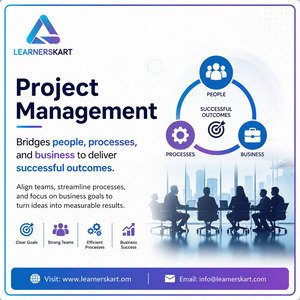
Project Management Bridges People, Processes, and Business to Deliver Successful Outcomes
-
June 3, 2026
In today’s fast-paced and highly competitive business environment, organizations are constantly striving to achieve strategic goals, improve operational efficiency, and deliver value to customers. Behind every successful product launch, business transformation, system implementation, or process improvement initiative, there is often a well-managed project driving the effort.
Project Management is much more than managing schedules and tracking tasks. It serves as the critical bridge between people, processes, and business objectives, ensuring that ideas are transformed into measurable results.
The Role of Project Management in Modern Organizations
Organizations invest significant resources in projects to create new products, improve services, expand operations, adopt new technologies, and gain competitive advantages. However, even the best ideas can fail without proper planning, coordination, and execution.
Project Management provides the structure, governance, and leadership needed to guide projects from initiation to completion. It ensures that project objectives align with business goals while balancing scope, schedule, cost, quality, risks, and stakeholder expectations.
A skilled Project Manager acts as a central point of coordination, bringing together diverse teams, stakeholders, and resources to achieve a common objective.
Bridging People
Projects are ultimately delivered by people. Regardless of technology, tools, or methodologies, success depends on effective collaboration among team members, sponsors, customers, vendors, and stakeholders.
Project Managers play a vital role in:
- Building high-performing teams
- Facilitating communication and collaboration
- Managing stakeholder expectations
- Resolving conflicts
- Motivating team members
- Creating accountability and ownership
- Supporting decision-making processes
Strong leadership and communication skills enable Project Managers to align individuals with project goals and foster an environment where teams can perform at their best.
Bridging Processes
Successful projects require structured processes that guide planning, execution, monitoring, and control activities. Without standardized processes, projects often experience delays, budget overruns, scope creep, and quality issues.
Project Management helps organizations establish and follow processes that improve consistency and predictability. These processes include:
- Project initiation and planning
- Requirements gathering
- Risk management
- Resource planning
- Quality management
- Change control
- Performance monitoring
- Project closure and lessons learned
By implementing proven frameworks and methodologies, Project Managers ensure that projects are executed efficiently while maintaining control over risks and changes.
Bridging Business Objectives
Projects exist to create business value. Every project should support strategic goals and contribute to organizational success.
Project Managers ensure that project outcomes align with business objectives by:
- Understanding organizational priorities
- Defining clear project goals
- Measuring project benefits
- Managing budgets effectively
- Delivering expected outcomes
- Maximizing return on investment
- Supporting business transformation initiatives
This business-focused approach helps organizations make informed decisions and ensures that projects deliver meaningful results rather than simply completing tasks.
Why Project Management Matters More Than Ever
Today’s organizations face increasing complexity due to globalization, digital transformation, evolving customer expectations, and rapidly changing market conditions.
As a result, businesses need professionals who can:
- Lead cross-functional teams
- Manage uncertainty and risks
- Drive innovation
- Deliver projects efficiently
- Align initiatives with strategic goals
- Adapt to changing business environments
Project Management provides the knowledge, tools, and leadership capabilities necessary to navigate these challenges successfully.
Building a Successful Career in Project Management
Project Management is one of the most rewarding and versatile career paths available today. Professionals with project management skills are in demand across industries including IT, manufacturing, healthcare, construction, finance, telecommunications, automotive, and consulting.
Earning globally recognized certifications such as PMP®, CAPM®, PRINCE2®, Agile certifications, and Lean Six Sigma credentials can significantly enhance career opportunities and professional credibility.
Organizations increasingly seek certified professionals who can successfully manage projects, lead teams, and deliver business value.
Final Thoughts
Project Management is not simply about managing timelines and budgets. It is the discipline that bridges people, processes, and business objectives to deliver successful outcomes.
By aligning teams, implementing effective processes, and focusing on strategic goals, Project Managers help organizations transform ideas into reality, overcome challenges, and achieve sustainable growth.
In an increasingly complex world, Project Management remains one of the most valuable skills for driving business success and creating lasting impact.
About Learnerskart
Learnerskart is a leading professional certification training provider helping working professionals accelerate their careers through globally recognized certifications.
🌐 Visit: www.learnerskart.com | #x1f4e7; Email: info@learnerskart.com
✔️ Follow us for PM tips amp; career insights: https://lnkd.in/gYB4Dw4K
Empowering professionals worldwide with industry-recognized certifications and career advancement opportunities.
Tags:
Business StrategyBusiness SuccessBusiness TransformationCareer DevelopmentLeadershipLearnersKartOrganizational GrowthPMOPMPPMP certificationProcess Improvementproject executionProject Governanceproject leadershipProject ManagementProject Managerproject planningStakeholder Managementstrategic managementteam management
You May Also Like
-
Jun 2, 2026
In many organizations, project management is often associated with schedules, trackers, dashboards, status reports, and governance meetings. While these tools...
-
May 8, 2026
Managing projects today is more complicated than ever. Project managers are expected to track schedules, budgets, resources, risks, issues, deadlines,...
-
May 7, 2026
Breaking into project management—or leveling up within it—doesn’t just depend on theory. It’s about how effectively you plan, collaborate, track,...
-
May 6, 2026
In today’s fast-paced project environments, success isn’t driven by tools, dashboards, or methodologies alone. While frameworks like Agile or predictive...
Sign up to receive our latest updates
Company
Support
Service Offerings
Special Offers
Get in touch
India
Call us directly?
+91-984-459-1589
Address
Learnerskart Solutions Pvt Ltd
4th floor, No: 207/189, 9th Main Rd, 6th Sector,
HSR Layout, Bengaluru, Karnataka 560102
info@learnerskart.com
USA
Call us directly?
+1 (307)-998-3816
Address
Learnerskart Americas LLC
30 N Gould St Ste R
Sheridan, WY 82801
info@learnerskart.com
Quick Contact
Trending Categories
Disclaimer
“PMI®”, “PMBOK®”, “PMP®”, “CAPM®” and “PMI-ACP®” are registered marks of the Project Management Institute, Inc.
ITIL® and PRINCE2® are registered trade marks of AXELOS Limited, used under permission of AXELOS Limited. All rights reserved.
“CSM”, “CST” are Registered Trade Marks of The Scrum Alliance, USA.
