
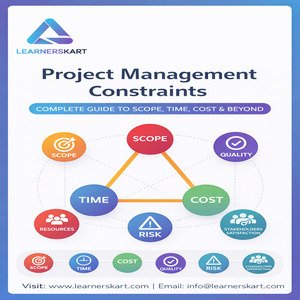
Project Management Constraints: The Complete Guide to Scope, Time, Cost & Beyond
-
February 26, 2026
In today’s fast-paced business environment, projects are becoming more complex, deadlines tighter, and budgets more scrutinized than ever. Whether you’re building a software product, launching a marketing campaign, or implementing a digital transformation initiative, one reality remains constant:
Every project operates within constraints.
Understanding and balancing these constraints is what separates an average project manager from a high-performing one.
In this complete guide, we’ll explore:
-
What project management constraints are
-
The Triple Constraint (Scope, Time, Cost)
-
Modern expanded constraints
-
Real-world examples
-
Practical strategies to balance them effectively
What Are Project Management Constraints?
Project management constraints are the limitations or restrictions that impact how a project is planned, executed, and delivered.
They define the boundaries within which a project must operate. These boundaries influence decisions related to resources, timelines, deliverables, and overall performance.
According to the Project Management Institute (PMI), managing competing constraints is one of the core responsibilities of a project manager.
The Triple Constraint (Iron Triangle)
The most widely recognized model in project management is the Triple Constraint, also known as the Iron Triangle.
It consists of three primary constraints:
1️⃣ Scope
2️⃣ Time
3️⃣ Cost
These three are interconnected. A change in one will almost always affect at least one of the others.
Let’s understand each in depth.
1️⃣ Scope – What Are We Delivering?
Scope defines the work required to deliver a product, service, or result. It includes:
-
Features
-
Requirements
-
Functionalities
-
Deliverables
If scope increases (for example, adding new features), you will likely need:
-
More time
-
More budget
-
More resources
Poor scope management leads to scope creep, one of the most common reasons projects fail.
2️⃣ Time – When Must It Be Delivered?
Time refers to the project schedule, deadlines, and milestones.
Time constraints include:
-
Project start and end dates
-
Phase deadlines
-
Critical path activities
If the deadline is shortened:
-
Costs March increase (overtime, additional staff)
-
Scope March need reduction
-
Quality might be compromised
Time pressure is one of the biggest stress factors in project environments.
3️⃣ Cost – What Is the Budget?
Cost includes all financial resources required for the project:
-
Labor
-
Equipment
-
Materials
-
Software
-
Infrastructure
When budgets are reduced:
-
Scope often shrinks
-
Timelines extend
-
Quality risks increase
Cost overruns are a major concern for stakeholders and sponsors.
Why It’s Called a Triangle
Imagine a triangle with Scope, Time, and Cost at each corner.
If you push one corner outward, the others must adjust.
For example:
-
Increase scope → More time and/or cost
-
Reduce time → Increase cost or reduce scope
-
Cut budget → Reduce scope or extend schedule
This balancing act is at the heart of professional project management.
Beyond the Triple Constraint: Modern Project Constraints
While the Triple Constraint is foundational, modern project management recognizes additional constraints that influence success.
Let’s explore them.
4️⃣ Quality
Delivering on time and within budget means nothing if the product fails quality standards.
Quality ensures:
-
Requirements are met
-
Customer expectations are satisfied
-
Compliance standards are maintained
Sometimes, compressing schedules or cutting costs directly impacts quality.
5️⃣ Resources
Resources include:
-
Skilled team members
-
Tools and technology
-
Equipment
-
Physical space
Limited availability of skilled professionals is a growing challenge across industries.
6️⃣ Risk
Risk represents uncertainty that can positively or negatively impact a project.
Examples:
-
Market changes
-
Technology failures
-
Vendor delays
-
Regulatory updates
Proactive risk management reduces the impact of constraints shifting unexpectedly.
7️⃣ Stakeholder Satisfaction
Even if scope, cost, and time are balanced, a project March still fail if stakeholders are unhappy.
Stakeholder constraints involve:
-
Expectations
-
Communication
-
Engagement
-
Alignment with business goals
Modern project success includes value delivery, not just triangle balancing.
Real-Life Example: Building a Mobile App
Let’s humanize this concept with a simple example.
Imagine you’re developing a mobile app.
Scenario 1:
The client wants 5 new features added.
→ Scope increases.
→ You need more developers (Cost increases).
→ Deadline March extend (Time increases).
Scenario 2:
The client wants it delivered 2 months earlier.
→ Time decreases.
→ Hire more developers (Cost increases).
OR
→ Reduce features (Scope decreases).
Scenario 3:
Budget is cut by 20%.
→ Reduce features (Scope decreases).
OR
→ Extend timeline (Time increases).
This is constraint balancing in action.
How to Effectively Balance Project Constraints
Here are practical strategies used by experienced project managers:
✔ Define Clear Scope Early
Use detailed requirement gathering and stakeholder alignment sessions.
✔ Prioritize Requirements
Classify as Must-Have, Should-Have, Could-Have.
✔ Build Realistic Schedules
Avoid optimistic timelines without buffer.
✔ Monitor Costs Continuously
Use earned value management and financial tracking.
✔ Communicate Transparently
Early communication prevents late surprises.
✔ Apply Change Control
Every change must be evaluated for impact on time, cost, and scope.
Common Mistakes in Managing Constraints
🚫 Ignoring stakeholder expectations
🚫 Accepting uncontrolled scope changes
🚫 Underestimating risks
🚫 Poor communication
🚫 Unrealistic deadlines
Avoiding these mistakes significantly increases project success rates.
Why Understanding Constraints Is Critical for Certification Aspirants
If you are preparing for PMP® or PRINCE2®, project constraints are foundational concepts.
The A Guide to the Project Management Body of Knowledge emphasizes balancing competing constraints as a core project manager responsibility.
Exam questions often test your ability to:
-
Analyze trade-offs
-
Handle change requests
-
Evaluate impact on schedule and cost
-
Protect quality
Understanding constraints is not just theoretical — it’s exam-critical.
Final Thoughts
Project Management Constraints are not obstacles. They are realities.
Success does not come from eliminating constraints — it comes from balancing them intelligently.
The best project managers:
-
Think strategically
-
Communicate clearly
-
Anticipate risks
-
Make informed trade-offs
-
Protect stakeholder value
When you master Scope, Time, Cost — and go beyond them — you move from managing tasks to leading successful projects.
🚀 Ready to Strengthen Your Project Management Skills?
If you’re preparing for PMP®, PRINCE2®, Lean Six Sigma, or other professional certifications, expert guidance can accelerate your success.
Learnerskart provides professional certification training and exam assistance for career-oriented programs across industries.
🌐 Visit: learnerskart.com | #x1f4e7; Email: info@learnerskart.com
✔️ Follow us for PM tips amp; career insights: https://lnkd.in/gYB4Dw4K
Empower your career with globally recognized certifications and practical project management expertise.
Tags:
You May Also Like
-
Mar 20, 2026
Introduction In today’s competitive and fast-paced business environment, delivering projects successfully is more challenging than ever. Many projects fail—not due...
-
Mar 18, 2026
Most PMP aspirants believe success comes from memorizing the PMBOK® Guide and solving hundreds of questions. But here’s the truth:...
-
Mar 17, 2026
In many organisations, the role of a Project Manager is often misunderstood. Some people believe that a great Project Manager...
-
Mar 9, 2026
The Project Management Institute (PMI) has announced a major update to the Project Management Professional (PMP®) certification exam, effective March...
Sign up to receive our latest updates
Company
Support
Service Offerings
Special Offers
Get in touch
India
Call us directly?
+91-984-459-1589
Address
Learnerskart Solutions Pvt Ltd
4th floor, No: 207/189, 9th Main Rd, 6th Sector,
HSR Layout, Bengaluru, Karnataka 560102
info@learnerskart.com
USA
Call us directly?
+1 (307)-998-3816
Address
Learnerskart Americas LLC
30 N Gould St Ste R
Sheridan, WY 82801
info@learnerskart.com
Quick Contact
Trending Categories
Disclaimer
“PMI®”, “PMBOK®”, “PMP®”, “CAPM®” and “PMI-ACP®” are registered marks of the Project Management Institute, Inc.
ITIL® and PRINCE2® are registered trade marks of AXELOS Limited, used under permission of AXELOS Limited. All rights reserved.
“CSM”, “CST” are Registered Trade Marks of The Scrum Alliance, USA.
