Project Management Success Wheel: 8 Key Elements Every PMP Aspirant Must Master
-
March 20, 2026
Introduction
In today’s competitive and fast-paced business environment, delivering projects successfully is more challenging than ever. Many projects fail—not due to lack of effort, but because critical elements are overlooked.
So, what ensures consistent project success?
The answer lies in a structured approach known as the Project Management Success Wheel—a powerful framework that integrates all essential components required to deliver successful projects.
Whether you’re a beginner, a working professional, or preparing for PMP certification, this framework can help you build a strong foundation and achieve better project outcomes.
What is the Project Management Success Wheel?
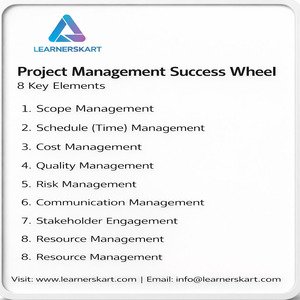
The Project Management Success Wheel is a visual and strategic framework that highlights the 8 key elements required to manage a project effectively.
At the center of the wheel lies: #x1f449; Project Objectives / Business Value
Surrounding it are the 8 essential components that must work together in balance. If even one element is weak, it can impact the entire project.
The 8 Key Elements of the Success Wheel
1. Scope Management
Scope defines what is included—and excluded—in a project.
Why it matters:
-
Prevents scope creep
-
Aligns expectations with stakeholders
-
Reduces rework
Common mistake: Poor requirement gathering leading to project delays.
2. Schedule (Time) Management
Time management ensures the project is completed within the defined timeline.
Key focus areas:
-
Activity sequencing
-
Timeline estimation
-
Milestone tracking
Pro Tip: Use tools like MS Project or Primavera for effective scheduling.
3. Cost Management
Every project operates within a budget. Managing costs effectively ensures financial success.
Includes:
-
Budget planning
-
Cost estimation
-
Cost control
Risk: Budget overruns can impact project viability.
4. Quality Management
Delivering a project is not enough—it must meet predefined quality standards.
Focus areas:
-
Quality planning
-
Quality assurance
-
Quality control
Example: Ensuring deliverables meet customer expectations and compliance requirements.
5. Risk Management
Risks are inevitable in any project. Successful project managers anticipate and mitigate them.
Steps involved:
-
Risk identification
-
Risk analysis
-
Risk response planning
Reality: Ignoring risks is one of the leading causes of project failure.
6. Communication Management
Effective communication ensures all stakeholders are aligned.
Why it matters:
-
Reduces misunderstandings
-
Improves team coordination
-
Enhances transparency
Best practice: Create a communication plan at the start of the project.
7. Stakeholder Engagement
Stakeholders play a critical role in project success.
Key activities:
-
Identifying stakeholders
-
Understanding expectations
-
Managing engagement levels
Mistake to avoid: Ignoring key stakeholders until problems arise.
8. Resource Management
The right resources are essential for project execution.
Includes:
-
Team allocation
-
Skill management
-
Resource optimization
Challenge: Balancing workload across team members.
How the Success Wheel Works
Think of the Success Wheel as a balanced system:
-
Each element supports the others
-
Weakness in one area affects the entire project
-
Strong alignment leads to predictable success
👉 The goal is not perfection—but balance and consistency
Real-World Example
Consider a project where:
-
Scope is unclear
-
Communication is weak
-
Risks are ignored
Even if the team is skilled, the project is likely to fail.
However, by applying the Success Wheel, project managers can:
-
Identify gaps early
-
Improve coordination
-
Deliver projects successfully
Why This Framework is Important for PMP Aspirants
The Project Management Success Wheel aligns closely with PMP exam domains:
-
People: Communication, Stakeholders, Resources
-
Process: Scope, Schedule, Cost, Quality, Risk
-
Business Environment: Value delivery
👉 Mastering this framework helps you:
-
Understand real-world scenarios
-
Solve situational PMP questions
-
Apply concepts practically in your job
Benefits of Using the Success Wheel
-
Improves project success rate
-
Enhances team collaboration
-
Reduces risks and delays
-
Builds strong project management skills
-
Prepares you for PMP certification
Final Thoughts
Project success is not accidental—it is the result of structured planning, effective execution, and continuous monitoring.
The Project Management Success Wheel provides a simple yet powerful way to manage all critical aspects of a project.
By mastering these 8 elements, you can: #x2714; Deliver projects on time
✔ Stay within budget
✔ Meet quality expectations
✔ Advance your project management career
Start Your PMP Journey with Learnerskart
If you’re planning to become a certified Project Management Professional (PMP), having the right training and support is essential.
Learnerskart offers:
-
PMP Certification Training aligned with PMI standards
-
35 PDUs required for exam eligibility
-
Step-by-step application support
-
Real exam-based practice questions
-
Flexible learning options with EMI
-
End-to-end guidance until certification
📞 Contact Learnerskart
🌐 Visit: www.learnerskart.com | #x1f4e7; Email: info@learnerskart.com
✔️ Follow us for PM tips amp; career insights: https://lnkd.in/gYB4Dw4K
Tags:
Agile Project ManagementCommunication Managementcost managementLearn Project ManagementPMIPMP certificationPMP exam preparationPMP trainingProject Managementproject management frameworkproject manager skillsproject planningproject success factorsProject Success Wheelquality managementResource ManagementRisk ManagementScope ManagementStakeholder Managementtime management
You May Also Like
-
Mar 18, 2026
Most PMP aspirants believe success comes from memorizing the PMBOK® Guide and solving hundreds of questions. But here’s the truth:...
-
Mar 17, 2026
In many organisations, the role of a Project Manager is often misunderstood. Some people believe that a great Project Manager...
-
Mar 9, 2026
The Project Management Institute (PMI) has announced a major update to the Project Management Professional (PMP®) certification exam, effective March...
-
Mar 6, 2026
In today’s fast-paced business environment, organizations run multiple projects simultaneously to achieve strategic goals, improve operational efficiency, and stay competitive....
Sign up to receive our latest updates
Company
Support
Service Offerings
Special Offers
Get in touch
India
Call us directly?
+91-984-459-1589
Address
Learnerskart Solutions Pvt Ltd
4th floor, No: 207/189, 9th Main Rd, 6th Sector,
HSR Layout, Bengaluru, Karnataka 560102
info@learnerskart.com
USA
Call us directly?
+1 (307)-998-3816
Address
Learnerskart Americas LLC
30 N Gould St Ste R
Sheridan, WY 82801
info@learnerskart.com
Quick Contact
Trending Categories
Disclaimer
“PMI®”, “PMBOK®”, “PMP®”, “CAPM®” and “PMI-ACP®” are registered marks of the Project Management Institute, Inc.
ITIL® and PRINCE2® are registered trade marks of AXELOS Limited, used under permission of AXELOS Limited. All rights reserved.
“CSM”, “CST” are Registered Trade Marks of The Scrum Alliance, USA.
