
Project Manager vs Project Leader: Key Differences, Skills & Mindset
-
February 19, 2026
In today’s fast-changing business environment, delivering projects on time and within budget is no longer enough.
Organisations are no longer looking for someone who can simply manage tasks. They are looking for professionals who can lead teams, influence stakeholders, and drive strategic value.
This raises an important question:
Is there a difference between a Project Manager and a Project Leader?
The answer is yes — and understanding this difference can completely transform your career.
Let’s explore it in a practical, real-world way.
What Is a Project Manager?
A Project Manager is responsible for planning, executing, monitoring, and closing a project successfully.
Their primary focus is on:
-
Scope management
-
Schedule control
-
Budget management
-
Risk identification amp; mitigation
-
Quality assurance
-
Stakeholder communication
Global standards defined by the Project Management Institute (PMI) guide how projects should be managed effectively. Certifications like the Project Management Professional (PMP®) validate a professional’s expertise in structured project management practices.
A strong project manager ensures:
-
The right resources are allocated
-
Tasks are tracked regularly
-
Risks are addressed proactively
-
Deliverables meet expectations
In simple terms:
👉 A Project Manager ensures the project is delivered successfully.
And that role is absolutely critical.
What Is a Project Leader?
A Project Leader goes one step further.
They don’t just manage processes — they lead people.
Instead of only focusing on “What needs to be done?”, a project leader also asks:
-
Why are we doing this project?
-
How does this align with business goals?
-
Is the team motivated and aligned?
-
Do stakeholders trust our direction?
A Project Leader:
-
Inspires confidence during uncertainty
-
Encourages collaboration
-
Builds strong team ownership
-
Aligns project outcomes with strategic objectives
-
Handles conflict with emotional intelligence
👉 A Project Leader ensures the project creates impact — not just output.
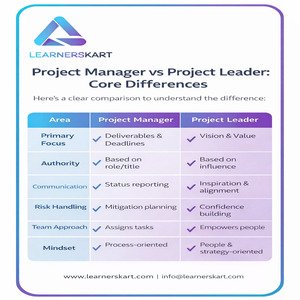
Project Manager vs Project Leader: Core Differences
Here’s a clear comparison to understand the difference:
| Area | Project Manager | Project Leader |
|---|---|---|
| Primary Focus | Deliverables amp; Deadlines | Vision amp; Value |
| Authority | Based on role/title | Based on influence |
| Communication | Status reporting | Inspiration amp; alignment |
| Risk Handling | Mitigation planning | Confidence building |
| Team Approach | Assigns tasks | Empowers people |
| Mindset | Process-oriented | People amp; strategy-oriented |
Both roles are important.
But leadership amplifies effectiveness.
Why Leadership Matters More Than Ever
The modern workplace has evolved:
-
Teams are remote or hybrid
-
Projects are more complex
-
Technology changes rapidly
-
Stakeholders expect agility and faster delivery
In this environment, managing schedules alone is not enough.
Organizations now prioritize:
-
Emotional intelligence
-
Strategic thinking
-
Change management capability
-
Stakeholder influence
-
Strong communication skills
In fact, evolving standards from the Project Management Institute now emphasize leadership and “power skills” alongside technical competencies.
The shift is clear:
Technical skills get you the job.
Leadership skills grow your career.
The Mindset Shift: From Manager to Leader
Becoming a project leader doesn’t require a new designation. It requires a new mindset.
1️⃣ From Control → To Trust
Empower your team instead of micromanaging.
2️⃣ From Reporting → To Storytelling
Communicate purpose, not just progress.
3️⃣ From Authority → To Influence
Leadership is earned through credibility and consistency.
4️⃣ From Tasks → To Business Value
Focus on outcomes that create measurable impact.
This transformation is what separates average project managers from exceptional professionals.
A Practical Example
Consider two project managers working on the same project.
Manager A:
-
Tracks deadlines strictly
-
Escalates issues immediately
-
Focuses only on scope compliance
Manager B:
-
Aligns the project with organizational strategy
-
Motivates the team during pressure
-
Builds stakeholder confidence
-
Encourages innovation
Both March complete the project successfully.
But Manager B builds long-term value, stronger teams, and greater trust.
That is leadership in action.
Can You Become Both?
Absolutely.
The most successful professionals are not “either-or.”
They are:
-
Structured like a manager
-
Strategic like a leader
-
Analytical in decision-making
-
Empathetic in people management
Certifications such as the Project Management Professional (PMP®) help you build strong technical foundations. When combined with leadership development, they position you for higher roles and greater responsibilities.
The goal is not just to manage projects.
The goal is to lead transformation.
Final Thoughts
Being a Project Manager ensures execution.
Being a Project Leader ensures success, sustainability, and strategic impact.
In today’s competitive environment, organizations don’t just need someone who can manage tasks — they need professionals who can guide teams through uncertainty, inspire performance, and deliver business value.
So ask yourself:
👉 Are you managing projects — or leading them?
Your answer could define your career growth.
🚀 Take the Next Step in Your Project Management Career
If you want to strengthen both your technical expertise and leadership capability, structured professional training can accelerate your growth.
Learnerskart provides globally recognized project management certification training, including PMP® preparation programs designed to help professionals build real-world competence and exam success.
🌐 Visit: learnerskart.com | #x1f4e7; Email: info@learnerskart.com
✔️ Follow us for PM tips amp; career insights: https://lnkd.in/gYB4Dw4K
Whether you are starting your project management journey or aiming to move into leadership roles, investing in the right knowledge and mindset can make all the difference.
Tags:
You May Also Like
-
Mar 20, 2026
Introduction In today’s competitive and fast-paced business environment, delivering projects successfully is more challenging than ever. Many projects fail—not due...
-
Mar 18, 2026
Most PMP aspirants believe success comes from memorizing the PMBOK® Guide and solving hundreds of questions. But here’s the truth:...
-
Mar 17, 2026
In many organisations, the role of a Project Manager is often misunderstood. Some people believe that a great Project Manager...
-
Mar 9, 2026
The Project Management Institute (PMI) has announced a major update to the Project Management Professional (PMP®) certification exam, effective March...
Sign up to receive our latest updates
Company
Support
Service Offerings
Special Offers
Get in touch
India
Call us directly?
+91-984-459-1589
Address
Learnerskart Solutions Pvt Ltd
4th floor, No: 207/189, 9th Main Rd, 6th Sector,
HSR Layout, Bengaluru, Karnataka 560102
info@learnerskart.com
USA
Call us directly?
+1 (307)-998-3816
Address
Learnerskart Americas LLC
30 N Gould St Ste R
Sheridan, WY 82801
info@learnerskart.com
Quick Contact
Trending Categories
Disclaimer
“PMI®”, “PMBOK®”, “PMP®”, “CAPM®” and “PMI-ACP®” are registered marks of the Project Management Institute, Inc.
ITIL® and PRINCE2® are registered trade marks of AXELOS Limited, used under permission of AXELOS Limited. All rights reserved.
“CSM”, “CST” are Registered Trade Marks of The Scrum Alliance, USA.
