
Project Planning vs Project Scheduling: Key Differences | Learnerskart
-
February 27, 2026
In project management, two terms are often used interchangeably — project planning and project scheduling.
But here’s the truth: they are not the same thing.
Many project delays, cost overruns, and execution failures happen because teams confuse planning with scheduling. Understanding the difference is not just academic — it directly impacts project success.
Whether you’re an aspiring PMP, a practising project manager, or someone new to the profession, this guide will clearly explain:
-
What project planning really means
-
What project scheduling actually involves
-
The key differences between them
-
Real-life examples
-
Common mistakes to avoid
Let’s break it down in simple terms.
What is Project Planning?
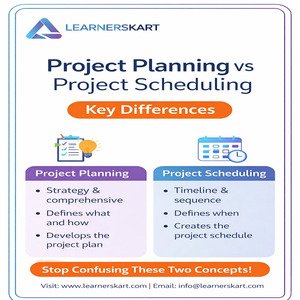
Project planning is the strategic foundation of a project.
It answers the big-picture questions:
-
What are we trying to achieve?
-
Why are we doing this project?
-
What is included — and what is not?
-
What resources do we need?
-
What risks might impact us?
-
How will we manage quality, communication, and stakeholders?
According to the standards set by the Project Management Institute, planning involves developing multiple subsidiary plans that together form the Project Management Plan.
Project Planning Includes:
-
Scope planning
-
Risk management planning
-
Cost planning
-
Resource planning
-
Communication planning
-
Quality planning
-
Procurement planning
-
Stakeholder engagement planning
Think of project planning as designing the blueprint of a house before construction begins.
Without planning, scheduling has no direction.
What is Project Scheduling?
Project scheduling is a subset of planning — but it focuses specifically on time.
Scheduling answers:
-
When will each task start?
-
When will it finish?
-
What depends on what?
-
What is the critical path?
-
What are the project milestones?
It converts the project plan into a timeline.
Project Scheduling Includes:
-
Creating Work Breakdown Structure (WBS)
-
Sequencing activities
-
Estimating durations
-
Developing a schedule
-
Identifying the critical path
-
Setting milestones
Scheduling uses tools like:
-
Gantt Charts
-
Network Diagrams
-
Critical Path Method (CPM)
-
Scheduling software like MS Project
If planning is the blueprint, scheduling is the construction calendar.
Key Differences Between Project Planning and Project Scheduling
| Aspect | Project Planning | Project Scheduling |
|---|---|---|
| Focus | Overall project strategy | Timeline and sequence |
| Scope | Broad and comprehensive | Time-specific |
| Includes | Scope, cost, risk, quality, communication | Activities, durations, dependencies |
| Output | Project Management Plan | Project Schedule |
| Nature | Strategic | Tactical |
| Question Answered | What amp; How? | When? |
A Simple Real-Life Example
Imagine you are organizing a wedding.
Project Planning Would Include:
-
Budget
-
Guest list
-
Venue selection
-
Catering decisions
-
Risk planning (what if it rains?)
-
Roles and responsibilities
Project Scheduling Would Include:
-
Engagement date
-
Invitation sending timeline
-
Vendor booking deadlines
-
Decoration setup time
-
Event day timeline
Planning decides what needs to be done.
Scheduling decides when it will be done.
Why People Confuse Planning and Scheduling
There are three main reasons:
1️⃣ Software Overdependence
Many managers jump straight into scheduling tools without properly planning.
2️⃣ Time Pressure
Organizations rush into timelines before defining scope clearly.
3️⃣ Lack of Structured PM Knowledge
Without structured understanding (like PMP preparation), professionals often mix these concepts.
Common Mistakes to Avoid
❌ Mistake 1: Creating a Schedule Without Clear Scope
If scope is unclear, the schedule will constantly change.
❌ Mistake 2: Treating Scheduling as Planning
A timeline alone does not define risk, quality, or stakeholder strategy.
❌ Mistake 3: Skipping Risk Planning
Schedules collapse when risks are not identified early.
Why This Difference Matters in Professional Certifications
For professionals preparing for certifications aligned with Project Management Institute standards, understanding this distinction is critical.
In the A Guide to the Project Management Body of Knowledge:
-
Planning processes cover multiple knowledge areas.
-
Scheduling falls specifically under Schedule Management.
Exam questions often test whether you understand that:
A schedule is developed after defining scope and activities.
How Planning and Scheduling Work Together
Planning and scheduling are not competitors — they are partners.
A strong project lifecycle looks like this:
-
Define objectives
-
Develop comprehensive project plan
-
Break work into activities
-
Sequence activities
-
Estimate durations
-
Develop schedule
-
Monitor and control
Without planning, scheduling becomes guesswork.
Without scheduling, planning remains theory.
Final Thoughts
Project planning and project scheduling serve different but interconnected purposes.
Planning sets the strategy.
Scheduling sets the timeline.
Confusing the two can lead to:
-
Scope creep
-
Delays
-
Budget overruns
-
Stakeholder dissatisfaction
But when used correctly, they create clarity, alignment, and predictable delivery.
If you want to grow as a project professional, mastering this distinction is essential not just for exams, but for real-world success.
Learnerskart offers professional certification training and exam-focused support for working professionals and aspiring project managers.
🌐 Visit: learnerskart.com | #x1f4e7; Email: info@learnerskart.com
✔️ Follow us for PM tips amp; career insights: https://lnkd.in/gYB4Dw4K
Take the next step toward becoming a confident and certified project professional.
Tags:
You May Also Like
-
Mar 26, 2026
📌 Introduction Over the past three decades, project management has evolved from a niche skill into a globally recognized profession....
-
Mar 20, 2026
Introduction In today’s competitive and fast-paced business environment, delivering projects successfully is more challenging than ever. Many projects fail—not due...
-
Mar 18, 2026
Most PMP aspirants believe success comes from memorizing the PMBOK® Guide and solving hundreds of questions. But here’s the truth:...
-
Mar 17, 2026
In many organisations, the role of a Project Manager is often misunderstood. Some people believe that a great Project Manager...
Sign up to receive our latest updates
Company
Support
Service Offerings
Special Offers
Get in touch
India
Call us directly?
+91-984-459-1589
Address
Learnerskart Solutions Pvt Ltd
4th floor, No: 207/189, 9th Main Rd, 6th Sector,
HSR Layout, Bengaluru, Karnataka 560102
info@learnerskart.com
USA
Call us directly?
+1 (307)-998-3816
Address
Learnerskart Americas LLC
30 N Gould St Ste R
Sheridan, WY 82801
info@learnerskart.com
Quick Contact
Trending Categories
Disclaimer
“PMI®”, “PMBOK®”, “PMP®”, “CAPM®” and “PMI-ACP®” are registered marks of the Project Management Institute, Inc.
ITIL® and PRINCE2® are registered trade marks of AXELOS Limited, used under permission of AXELOS Limited. All rights reserved.
“CSM”, “CST” are Registered Trade Marks of The Scrum Alliance, USA.
