
Project Risk Management: Probability vs Impact Explained
-
February 20, 2026
Have you ever worried about something that never actually happened?
Or ignored something small that later turned into a big problem?
That’s exactly how project risks work.
In every project — whether it’s launching a website, constructing a building, implementing software, or organizing an event — uncertainty exists. But successful project managers don’t fear uncertainty. They understand it.
At the heart of risk management are two powerful concepts:
Probability – How likely is it to happen?
Impact – If it happens, how bad will it be?
When you understand these two clearly, you stop reacting emotionally and start managing risks professionally.
What Is Project Risk?
According to the Project Management Institute (PMI), a project risk is:
“An uncertain event or condition that, if it occurs, has a positive or negative effect on one or more project objectives.”
In simple words:
Risk = Something that might happen and affect your project.
Notice the word might.
If it is guaranteed to happen, it’s not a risk — it’s an issue.
Step 1: Understanding Probability
Probability answers one simple question:
“How likely is this to happen?”
It does NOT measure damage.
It only measures likelihood.
Examples:
-
A team member taking sick leave → Medium probability
-
A server crash during launch → Low probability
-
Minor reporting errors → High probability
Probability can be measured:
-
As a percentage (30%, 70%)
-
On a scale (Low / Medium / High)
-
Or using numbers (1–5)
But remember:
Something happening often doesn’t automatically mean it is dangerous.
Step 2: Understanding Impact
Impact answers another important question:
“If this happens, how badly will it affect the project?”
Impact measures consequences.
It can affect:
-
Budget
-
Timeline
-
Quality
-
Scope
-
Reputation
-
Customer satisfaction
Examples:
-
Spilling coffee on a printed report → Low impact
-
Website outage during a major sale → High impact
-
Accidentally deleting a critical file → Very high impact
Impact measures severity — not likelihood.
Why Probability Alone Is Not Enough
Here’s where many project managers go wrong.
They panic about risks that happen frequently but cause little damage.
Or worse — they ignore rare risks that could destroy the project.
Professional risk management means evaluating both probability and impact together.
The Simple Formula: Risk Score
In project management:
Risk Score = Probability × Impact
Let’s say:
-
Risk A: Happens often (4/5) but causes small damage (1/5)
Risk Score = 4 -
Risk B: Rare (2/5) but very damaging (5/5)
Risk Score = 10
Which one should you prioritize?
Risk B.
Even though it’s less likely, its impact is far more severe.
That’s smart risk management.
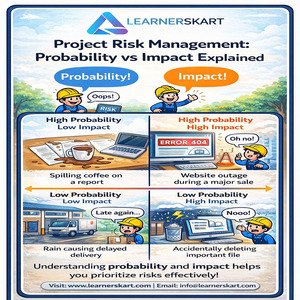
The Probability-Impact Matrix (Risk Matrix)
To visualize this, project managers use something called a Risk Matrix.
It maps:
-
Probability on one axis
-
Impact on the other
Risks that fall into:
🔴 High Probability + High Impact → Immediate action
🟠 Low Probability + High Impact → Strong mitigation plan
🟡 High Probability + Low Impact → Monitor
🟢 Low Probability + Low Impact → Accept
This structured approach is widely used in global frameworks like:
-
Project Management Institute
-
AXELOS (PRINCE2)
Real-Life Scenarios Made Simple
Let’s humanize this further.
1. High Probability + Low Impact
Your team frequently makes minor formatting mistakes in reports.
Annoying? Yes.
Dangerous? No.
Action → Monitor.
2. High Probability + High Impact
Your system often crashes during high-traffic periods.
This affects revenue and customer trust.
Action → Immediate mitigation.
3. Low Probability + Low Impact
A delivery vehicle March be delayed due to light rain.
Action → Accept.
4. Low Probability + High Impact
Your entire project database could be deleted accidentally.
Action → Backup systems, strict access control, contingency plan.
Common Mistakes in Risk Management
Even experienced professionals sometimes:
-
Focus only on frequent risks
-
Ignore catastrophic low-probability risks
-
Skip regular risk reviews
-
Fail to update the risk register
-
Avoid stakeholder discussions
Risk management is not a one-time activity.
It must continue throughout the project lifecycle.
Why This Concept Is Critical for PMP amp; PRINCE2 Aspirants
If you’re preparing for certifications like PMP or PRINCE2, understanding probability vs impact is essential.
In PMP, risk management includes:
-
Identifying risks
-
Performing qualitative analysis
-
Performing quantitative analysis
-
Planning responses
-
Monitoring risks
In PRINCE2, risk is managed using:
-
Risk register
-
Risk owner
-
Risk tolerance
-
Escalation rules
Both frameworks emphasize prioritizing risks using probability and impact.
Without mastering this concept, you cannot effectively answer scenario-based exam questions.
Final Thought: Risk Is Not the Enemy
Uncertainty will always exist.
The goal is not to eliminate risk.
The goal is to understand it, prioritize it, and respond intelligently.
When you evaluate both:
✔ How likely something is
✔ How severe the consequences are
You move from being reactive to becoming a confident project leader.
And that’s what separates certified professionals from average managers.
Ready to Master Risk Management?
If you’re planning to prepare for:
-
PMP Certification
-
CAPM
-
PRINCE2 Foundation amp; Practitioner
-
Lean Six Sigma
Learnerskart offers structured training, real-time examples, and exam-focused preparation designed for working professionals.
🌐 Visit: learnerskart.com | #x1f4e7; Email: info@learnerskart.com
✔️ Follow us for PM tips amp; career insights: https://lnkd.in/gYB4Dw4K
Take the next step in your project management journey with expert-led training and practical learning support.
Tags:
You May Also Like
-
Mar 20, 2026
Introduction In today’s competitive and fast-paced business environment, delivering projects successfully is more challenging than ever. Many projects fail—not due...
-
Mar 18, 2026
Most PMP aspirants believe success comes from memorizing the PMBOK® Guide and solving hundreds of questions. But here’s the truth:...
-
Mar 17, 2026
In many organisations, the role of a Project Manager is often misunderstood. Some people believe that a great Project Manager...
-
Mar 9, 2026
The Project Management Institute (PMI) has announced a major update to the Project Management Professional (PMP®) certification exam, effective March...
Sign up to receive our latest updates
Company
Support
Service Offerings
Special Offers
Get in touch
India
Call us directly?
+91-984-459-1589
Address
Learnerskart Solutions Pvt Ltd
4th floor, No: 207/189, 9th Main Rd, 6th Sector,
HSR Layout, Bengaluru, Karnataka 560102
info@learnerskart.com
USA
Call us directly?
+1 (307)-998-3816
Address
Learnerskart Americas LLC
30 N Gould St Ste R
Sheridan, WY 82801
info@learnerskart.com
Quick Contact
Trending Categories
Disclaimer
“PMI®”, “PMBOK®”, “PMP®”, “CAPM®” and “PMI-ACP®” are registered marks of the Project Management Institute, Inc.
ITIL® and PRINCE2® are registered trade marks of AXELOS Limited, used under permission of AXELOS Limited. All rights reserved.
“CSM”, “CST” are Registered Trade Marks of The Scrum Alliance, USA.
