
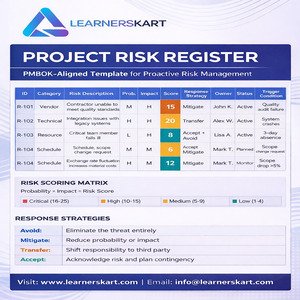
Project Risk Register: A PMBOK-Aligned Template for Proactive Risk Management
-
January 16, 2026
In today’s fast-paced and uncertain project environments, successful project managers don’t wait for risks to happen — they plan for them. One of the most powerful yet underutilized tools in project management is the Project Risk Register.
Aligned with the PMBOK Guide (7th Edition), a well-maintained risk register enables teams to identify, assess, prioritize, and respond to risks proactively, rather than reacting after damage has occurred.
In this blog, we’ll break down:
-
What a Project Risk Register is
-
Why is critical for project success
-
Key components of a PMBOK-aligned risk register
-
Example risk entries
-
Best practices used by high-performing project managers
What Is a Project Risk Register?
A Project Risk Register is a centralized document that captures all identified project risks along with their:
-
Probability
-
Impact
-
Risk score
-
Response strategy
-
Owner
-
Current status
According to PMBOK, it is a living document that evolves throughout the project lifecycle and supports continuous risk monitoring and control.
Why Is a Risk Register Important?
Projects fail not because risks exist — they fail because risks are ignored.
A structured risk register helps you:
✔ Anticipate potential threats early
✔ Prioritize high-impact risks
✔ Assign clear ownership
✔ Reduce surprises and delays
✔ Improve stakeholder confidence
✔ Increase project success rate
For PMP® aspirants, understanding the risk register is also exam-critical, as it connects directly to risk planning, risk response strategies, and governance.
PMBOK-Aligned Components of a Risk Register
A professional risk register typically includes the following fields:
1. Risk ID
A unique identifier (e.g., R-101, R-102) used for tracking and reporting.
2. Risk Category
Helps classify risks for better analysis. Common categories include:
-
Schedule
-
Cost / Budget
-
Technical
-
Resource
-
Vendor
-
External
3. Risk Description
A clear, concise statement describing the risk event and its cause.
4. Probability (Likelihood)
The chance that the risk will occur (Low / Medium / High).
5. Impact
The potential effect on scope, schedule, cost, or quality if the risk occurs.
6. Risk Score
Calculated as:
Risk Score = Probability × Impact
This helps prioritize risks objectively.
Example Risk Register Entries (Sample Data)
| ID | Category | Risk Description | Probability | Impact | Score | Response Strategy | Status |
|---|---|---|---|---|---|---|---|
| R-101 | Vendor | Contractor unable to meet quality standards | Medium | High | 15 | Mitigate | Active |
| R-102 | Technical | Integration issues with legacy systems | High | High | 20 | Transfer | Active |
| R-103 | Resource | Critical team member unavailable | Low | High | 8 | Accept + Avoid | Active |
| R-104 | Schedule | Schedule impact due to scope change requests | Medium | Medium | 6 | Accept | Planned |
| R-105 | Budget | Cost increase due to currency fluctuation | High | Medium | 12 | Mitigate | Monitor |
Risk Response Strategies (PMBOK Standard)
PMBOK defines four primary threat response strategies:
🔴 Avoid
Eliminate the risk by changing the project plan.
🟡 Mitigate
Reduce the probability or impact of the risk.
🔵 Transfer
Shift responsibility to a third party (e.g., insurance, outsourcing).
🟢 Accept
Acknowledge the risk and prepare contingency plans.
Risk Scoring Matrix Explained
A Risk Scoring Matrix visually represents risk severity:
-
Critical (16–25) – Immediate action required
-
High (10–15) – Management attention needed
-
Medium (5–9) – Monitor closely
-
Low (1–4) – Acceptable risk
This ensures the team focuses on what matters most.
Best Practices for Maintaining a Risk Register
✔ Review and update risks weekly
✔ Assign one clear risk owner per risk
✔ Track triggers to identify early warning signs
✔ Involve stakeholders during risk identification
✔ Use data-driven scoring, not assumptions
✔ Keep the register visible and accessible
Why This Matters for PMP® Aspirants
The PMP exam heavily tests risk concepts, including:
-
Risk identification
-
Qualitative and quantitative analysis
-
Risk response planning
-
Monitoring and control
Understanding how a real-world PMBOK-aligned risk register works gives you a strong edge — both in the exam and in real projects.
Final Thoughts
A Project Risk Register is more than a document — it’s a decision-making tool that separates reactive managers from proactive leaders.
By using a PMBOK-aligned risk register, you:
-
Improve project predictability
-
Reduce failures
-
Strengthen stakeholder trust
-
Demonstrate professional maturity
Whether you’re managing live projects or preparing for PMP®, mastering risk registers is non-negotiable.
Want PMP®-Aligned Templates, Training amp; Exam Support?
🌐 Visit: learnerskart.com | #x1f4e7; Email: info@learnerskart.com
✔️ Follow us for more project management tips amp; career insights! https://lnkd.in/gYB4Dw4K
Learnerskart helps professionals plan better, manage risks smarter, and pass certifications faster #x1f680;
Tags:
You May Also Like
-
Mar 20, 2026
Introduction In today’s competitive and fast-paced business environment, delivering projects successfully is more challenging than ever. Many projects fail—not due...
-
Mar 18, 2026
Most PMP aspirants believe success comes from memorizing the PMBOK® Guide and solving hundreds of questions. But here’s the truth:...
-
Mar 17, 2026
In many organisations, the role of a Project Manager is often misunderstood. Some people believe that a great Project Manager...
-
Mar 9, 2026
The Project Management Institute (PMI) has announced a major update to the Project Management Professional (PMP®) certification exam, effective March...
Sign up to receive our latest updates
Company
Support
Service Offerings
Special Offers
Get in touch
India
Call us directly?
+91-984-459-1589
Address
Learnerskart Solutions Pvt Ltd
4th floor, No: 207/189, 9th Main Rd, 6th Sector,
HSR Layout, Bengaluru, Karnataka 560102
info@learnerskart.com
USA
Call us directly?
+1 (307)-998-3816
Address
Learnerskart Americas LLC
30 N Gould St Ste R
Sheridan, WY 82801
info@learnerskart.com
Quick Contact
Trending Categories
Disclaimer
“PMI®”, “PMBOK®”, “PMP®”, “CAPM®” and “PMI-ACP®” are registered marks of the Project Management Institute, Inc.
ITIL® and PRINCE2® are registered trade marks of AXELOS Limited, used under permission of AXELOS Limited. All rights reserved.
“CSM”, “CST” are Registered Trade Marks of The Scrum Alliance, USA.
