Project vs Program vs Portfolio vs Operations: Roles, Risks & Success Measures
-
February 18, 2026
In today’s competitive business environment, organizations must balance strategy, execution, and stability. This is where understanding the difference between Projects, Programs, Portfolios, and Operations becomes critical.
Many professionals use these terms interchangeably — but they serve very different purposes.
According to the Project Management Institute (PMI), these four components form the backbone of structured organizational delivery and governance.
Let’s break them down clearly and practically.
1️⃣ What is a Project?
A Project is a temporary endeavor undertaken to create a unique product, service, or result.
🔹 Key Characteristics
-
Has a defined start and end date
-
Produces a unique deliverable
-
Operates within scope, cost, and schedule constraints
-
Managed by a Project Manager
🎯 Primary Objective
Deliver a specific output successfully.
⚠ Risk Focus
Delivery risk — delays, cost overruns, scope creep, quality issues.
📊 Success Measure
-
On time
-
On budget
-
In scope
-
Meets quality standards
📌 Example
Developing a mobile banking app.
2️⃣ What is a Program?
A Program is a group of related projects managed in a coordinated way to achieve benefits that cannot be obtained by managing them individually.
🔹 Key Characteristics
-
Contains multiple related projects
-
Focuses on long-term benefits
-
High stakeholder complexity
-
Managed by a Program Manager
🎯 Primary Objective
Realize benefits and build organizational capabilities.
⚠ Risk Focus
-
Interdependency risks
-
Benefit realization risks
-
Change resistance
📊 Success Measure
-
Achievement of expected benefits
-
Business value creation
-
Stakeholder satisfaction
📌 Example
Digital Transformation Program including:
-
Website revamp project
-
Mobile app project
-
CRM implementation project
3️⃣ What is a Portfolio?
A Portfolio is a collection of projects, programs, and sometimes operational initiatives that are grouped together to achieve strategic objectives.
🔹 Key Characteristics
-
March include unrelated initiatives
-
Strategic-level governance
-
Focused on investment decisions
-
Managed by a Portfolio Manager
🎯 Primary Objective
Maximize strategic value and optimize resource allocation.
⚠ Risk Focus
-
Investment risk
-
Market risk
-
Strategic misalignment
📊 Success Measure
-
Return on Investment (ROI)
-
Strategic alignment
-
Balanced risk vs reward
-
Optimal resource utilization
📌 Example
An IT Portfolio including:
-
Cybersecurity program
-
Infrastructure upgrade project
-
AI innovation initiative
4️⃣ What are Operations?
Operations are ongoing, repetitive activities that sustain the organization’s core business.
🔹 Key Characteristics
-
No defined end date
-
Process-driven
-
Stability and efficiency focused
-
Managed by Operations/Functional Managers
🎯 Primary Objective
Maintain business continuity and performance.
⚠ Risk Focus
-
Performance risk
-
Service level failure
-
Process inefficiencies
📊 Success Measure
-
Efficiency
-
Productivity
-
Service Level Agreements (SLAs)
-
Cost control
📌 Example
Daily banking transactions, payroll processing, customer support.
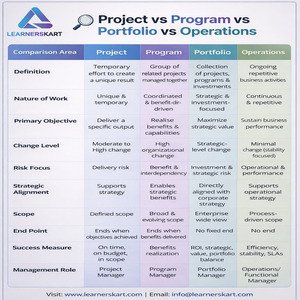
🔎 Detailed Comparison: Roles, Risks amp; Success Measures
| Area | Project | Program | Portfolio | Operations |
|---|---|---|---|---|
| Nature | Temporary amp; unique | Coordinated amp; benefit-driven | Strategic amp; investment-focused | Continuous amp; repetitive |
| Objective | Deliver output | Deliver benefits | Deliver strategic value | Sustain business |
| Risk Type | Delivery risk | Benefit amp; interdependency risk | Investment amp; strategic risk | Operational risk |
| Governance Level | Tactical | Tactical + Strategic | Strategic | Operational |
| Change Level | Moderate to High | High organizational change | Strategic-level change | Minimal change |
| End Point | Yes | Yes | No fixed end | No end |
| Success Focus | Scope, cost, schedule | Benefits realization | ROI amp; alignment | Efficiency amp; stability |
🎯 How They Work Together
Think of it like this:
-
Projects build deliverables
-
Programs integrate projects to generate benefits
-
Portfolios select and prioritize the right initiatives
-
Operations keep the organization running daily
Without projects, there is no innovation.
Without programs, there is no coordinated transformation.
Without portfolios, there is no strategy alignment.
Without operations, there is no stability.
💡 Real Corporate Scenario
Let’s consider a bank:
-
Launching a new mobile app → Project
-
Digital Banking Transformation → Program
-
IT Investment Strategy → Portfolio
-
Daily transaction processing → Operations
Each level serves a different but connected purpose.
📌 Why This Matters for Professionals
Understanding these differences helps you:
-
Prepare for PMP and other certifications
-
Align initiatives with organizational strategy
-
Communicate effectively with senior management
-
Avoid confusion between delivery and strategy roles
This distinction is frequently tested in PMP exams and is critical for leadership roles.
🚀 Final Thoughts
Projects create outputs.
Programs create outcomes.
Portfolios create strategy alignment.
Operations create stability.
When these four elements work together, organizations achieve both innovation and sustainability.
If you are preparing for professional certifications or want structured guidance on project management learning paths, you can explore professional training support at:
🌐 Visit: learnerskart.com | #x1f4e7; Email: info@learnerskart.com
✔️ Follow us for PM tips amp; career insights: https://lnkd.in/gYB4Dw4K
Tags:
benefits realizationGovernance in Project ManagementOperations ManagementOrganizational Change ManagementPMOPortfolio ManagementPortfolio vs Operationsprogram managementProgram vs PortfolioProject Managementproject risk managementproject success metricsProject vs Programstrategic managementStrategic Portfolio Management
You May Also Like
-
Mar 20, 2026
Introduction In today’s competitive and fast-paced business environment, delivering projects successfully is more challenging than ever. Many projects fail—not due...
-
Mar 18, 2026
Most PMP aspirants believe success comes from memorizing the PMBOK® Guide and solving hundreds of questions. But here’s the truth:...
-
Mar 17, 2026
In many organisations, the role of a Project Manager is often misunderstood. Some people believe that a great Project Manager...
-
Mar 9, 2026
The Project Management Institute (PMI) has announced a major update to the Project Management Professional (PMP®) certification exam, effective March...
Sign up to receive our latest updates
Company
Support
Service Offerings
Special Offers
Get in touch
India
Call us directly?
+91-984-459-1589
Address
Learnerskart Solutions Pvt Ltd
4th floor, No: 207/189, 9th Main Rd, 6th Sector,
HSR Layout, Bengaluru, Karnataka 560102
info@learnerskart.com
USA
Call us directly?
+1 (307)-998-3816
Address
Learnerskart Americas LLC
30 N Gould St Ste R
Sheridan, WY 82801
info@learnerskart.com
Quick Contact
Trending Categories
Disclaimer
“PMI®”, “PMBOK®”, “PMP®”, “CAPM®” and “PMI-ACP®” are registered marks of the Project Management Institute, Inc.
ITIL® and PRINCE2® are registered trade marks of AXELOS Limited, used under permission of AXELOS Limited. All rights reserved.
“CSM”, “CST” are Registered Trade Marks of The Scrum Alliance, USA.
