Why PMP Certification Demand Is Growing: A 30-Year Global Trend (1993–2025)
-
March 26, 2026
📌 Introduction
Over the past three decades, project management has evolved from a niche skill into a globally recognized profession. At the center of this transformation is the Project Management Professional (PMP®) certification offered by the Project Management Institute.
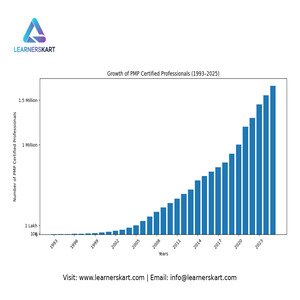
From just a few thousand certified professionals in the early 1990s to over 1.65 million PMP holders worldwide by 2025, the growth has been nothing short of extraordinary.
But what’s driving this surge in demand?
Let’s explore the data, trends, and career impact behind the PMP boom.
📊 30-Year Growth Snapshot
In 1993, there were only around 0 PMP-certified professionals globally. Fast forward to 2025, and that number has skyrocketed to 1,657,410.
This exponential growth reflects:
- 🌍 Global adoption of structured project management
- 🏢 Increased demand from organizations across industries
- 💼 Recognition of PMP as a gold standard certification
The rise is not just numerical—it represents a shift in how businesses operate and deliver value.
🚀 Key Reasons Behind the Growing Demand
1️⃣ Global Standardization of Project Management
Organizations today operate in a highly competitive and globalized environment. To stay ahead, they rely on standardized frameworks and best practices.
The PMP certification provides:
- A common project management language
- Proven methodologies (Predictive, Agile, Hybrid)
- Globally accepted standards
This makes PMP-certified professionals highly valuable across industries.
2️⃣ Rapid Digital Transformation
The last decade has seen massive digital disruption:
- Cloud computing
- AI amp; automation
- Remote work environments
Companies need skilled professionals to manage complex transformations. PMP-certified professionals bring structured execution and risk management, making them critical to success.
3️⃣ Increased Project Complexity
Modern projects are:
- Cross-functional
- Multi-location
- High-risk
Without proper management, failure rates increase significantly.
PMP professionals are trained to handle:
- Scope, schedule, and cost constraints
- Stakeholder communication
- Risk mitigation
This directly contributes to higher project success rates.
4️⃣ Strong Career and Salary Benefits
One of the biggest drivers of PMP demand is career growth.
According to industry reports:
- PMP-certified professionals earn 20–25% higher salaries on average
- Increased job opportunities across IT, construction, healthcare, finance, and more
For professionals, PMP is not just a certification—it’s a career accelerator.
5️⃣ Global Recognition Across Industries
Unlike many certifications limited to specific domains, PMP is industry-agnostic.
It is widely used in:
- IT amp; Software Development
- Construction amp; Engineering
- Healthcare
- Banking amp; Finance
- Manufacturing
This versatility makes PMP one of the most sought-after certifications worldwide.
🌍 Post-2020 Surge: A Turning Point
The demand for PMP saw a sharp rise after 2020, driven by:
- Remote project management needs
- Increased reliance on digital tools
- Organizational restructuring and transformation
Between 2020 and 2025 alone, the number of PMP professionals grew dramatically, crossing the 1 million mark and continuing upward.
📈 What This Means for Your Career
If you’re considering PMP certification, the trend is clear:
👉 Demand is growing
👉 Opportunities are expanding
👉 Competition is increasing
This means:
- Early adopters gain a competitive advantage
- PMP certification enhances credibility
- Employers actively prefer certified professionals
🎯 Why Now Is the Right Time to Get PMP Certified
With over 1.6 million professionals already certified, you might wonder—is it too late?
The answer is NO.
In fact:
- The demand for skilled project managers continues to outpace supply
- Organizations are prioritizing certified talent
- New domains (Agile, Hybrid, AI-driven projects) are expanding opportunities
Getting PMP certified now positions you for long-term career growth.
📌 How to Get Started
To earn PMP certification, you need:
- Project management experience
- 35 contact hours of training
- Preparation aligned with PMI exam standards
Choosing the right training partner is crucial for success.
📊 Conclusion
The journey from 0 PMP professionals in 1993 to over 1.65 million in 2025 highlights one clear fact:
👉 Project management is no longer optional—it’s essential.
As organizations continue to evolve, the demand for PMP-certified professionals will only grow stronger.
If you’re looking to future-proof your career, PMP certification is one of the smartest investments you can make today.
🚀 Advance Your Career with Learnerskart
At Learnerskart, we help professionals achieve PMP certification with:
- 🎓 Expert-led training programs
- 📚 Real exam-based practice questions
- 📝 Application amp; exam support
- 💡 Flexible learning options with EMI
🌐 Visit: www.learnerskart.com | #x1f4e7; Email: info@learnerskart.com
✔️ Follow us for PM tips amp; career insights: https://lnkd.in/gYB4Dw4K
You May Also Like
-
Mar 20, 2026
Introduction In today’s competitive and fast-paced business environment, delivering projects successfully is more challenging than ever. Many projects fail—not due...
-
Mar 18, 2026
Most PMP aspirants believe success comes from memorizing the PMBOK® Guide and solving hundreds of questions. But here’s the truth:...
-
Mar 17, 2026
In many organisations, the role of a Project Manager is often misunderstood. Some people believe that a great Project Manager...
-
Mar 9, 2026
The Project Management Institute (PMI) has announced a major update to the Project Management Professional (PMP®) certification exam, effective March...
Sign up to receive our latest updates
Company
Support
Service Offerings
Special Offers
Get in touch
India
Call us directly?
+91-984-459-1589
Address
Learnerskart Solutions Pvt Ltd
4th floor, No: 207/189, 9th Main Rd, 6th Sector,
HSR Layout, Bengaluru, Karnataka 560102
info@learnerskart.com
USA
Call us directly?
+1 (307)-998-3816
Address
Learnerskart Americas LLC
30 N Gould St Ste R
Sheridan, WY 82801
info@learnerskart.com
Quick Contact
Trending Categories
Disclaimer
“PMI®”, “PMBOK®”, “PMP®”, “CAPM®” and “PMI-ACP®” are registered marks of the Project Management Institute, Inc.
ITIL® and PRINCE2® are registered trade marks of AXELOS Limited, used under permission of AXELOS Limited. All rights reserved.
“CSM”, “CST” are Registered Trade Marks of The Scrum Alliance, USA.
