
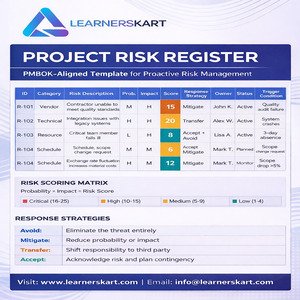
Project Risk Register: A PMBOK-Aligned Template for Proactive Risk Management
-
January 16, 2026
In today’s fast-paced and uncertain project environments, successful project managers don’t wait for risks to happen — they plan for them. One of the most powerful yet underutilized tools in project management is the Project Risk Register.
Aligned with the PMBOK Guide (7th Edition), a well-maintained risk register enables teams to identify, assess, prioritize, and respond to risks proactively, rather than reacting after damage has occurred.
In this blog, we’ll break down:
-
What a Project Risk Register is
-
Why is critical for project success
-
Key components of a PMBOK-aligned risk register
-
Example risk entries
-
Best practices used by high-performing project managers
What Is a Project Risk Register?
A Project Risk Register is a centralized document that captures all identified project risks along with their:
-
Probability
-
Impact
-
Risk score
-
Response strategy
-
Owner
-
Current status
According to PMBOK, it is a living document that evolves throughout the project lifecycle and supports continuous risk monitoring and control.
Why Is a Risk Register Important?
Projects fail not because risks exist — they fail because risks are ignored.
A structured risk register helps you:
✔ Anticipate potential threats early
✔ Prioritize high-impact risks
✔ Assign clear ownership
✔ Reduce surprises and delays
✔ Improve stakeholder confidence
✔ Increase project success rate
For PMP® aspirants, understanding the risk register is also exam-critical, as it connects directly to risk planning, risk response strategies, and governance.
PMBOK-Aligned Components of a Risk Register
A professional risk register typically includes the following fields:
1. Risk ID
A unique identifier (e.g., R-101, R-102) used for tracking and reporting.
2. Risk Category
Helps classify risks for better analysis. Common categories include:
-
Schedule
-
Cost / Budget
-
Technical
-
Resource
-
Vendor
-
External
3. Risk Description
A clear, concise statement describing the risk event and its cause.
4. Probability (Likelihood)
The chance that the risk will occur (Low / Medium / High).
5. Impact
The potential effect on scope, schedule, cost, or quality if the risk occurs.
6. Risk Score
Calculated as:
Risk Score = Probability × Impact
This helps prioritize risks objectively.
Example Risk Register Entries (Sample Data)
| ID | Category | Risk Description | Probability | Impact | Score | Response Strategy | Status |
|---|---|---|---|---|---|---|---|
| R-101 | Vendor | Contractor unable to meet quality standards | Medium | High | 15 | Mitigate | Active |
| R-102 | Technical | Integration issues with legacy systems | High | High | 20 | Transfer | Active |
| R-103 | Resource | Critical team member unavailable | Low | High | 8 | Accept + Avoid | Active |
| R-104 | Schedule | Schedule impact due to scope change requests | Medium | Medium | 6 | Accept | Planned |
| R-105 | Budget | Cost increase due to currency fluctuation | High | Medium | 12 | Mitigate | Monitor |
Risk Response Strategies (PMBOK Standard)
PMBOK defines four primary threat response strategies:
🔴 Avoid
Eliminate the risk by changing the project plan.
🟡 Mitigate
Reduce the probability or impact of the risk.
🔵 Transfer
Shift responsibility to a third party (e.g., insurance, outsourcing).
🟢 Accept
Acknowledge the risk and prepare contingency plans.
Risk Scoring Matrix Explained
A Risk Scoring Matrix visually represents risk severity:
-
Critical (16–25) – Immediate action required
-
High (10–15) – Management attention needed
-
Medium (5–9) – Monitor closely
-
Low (1–4) – Acceptable risk
This ensures the team focuses on what matters most.
Best Practices for Maintaining a Risk Register
✔ Review and update risks weekly
✔ Assign one clear risk owner per risk
✔ Track triggers to identify early warning signs
✔ Involve stakeholders during risk identification
✔ Use data-driven scoring, not assumptions
✔ Keep the register visible and accessible
Why This Matters for PMP® Aspirants
The PMP exam heavily tests risk concepts, including:
-
Risk identification
-
Qualitative and quantitative analysis
-
Risk response planning
-
Monitoring and control
Understanding how a real-world PMBOK-aligned risk register works gives you a strong edge — both in the exam and in real projects.
Final Thoughts
A Project Risk Register is more than a document — it’s a decision-making tool that separates reactive managers from proactive leaders.
By using a PMBOK-aligned risk register, you:
-
Improve project predictability
-
Reduce failures
-
Strengthen stakeholder trust
-
Demonstrate professional maturity
Whether you’re managing live projects or preparing for PMP®, mastering risk registers is non-negotiable.
Want PMP®-Aligned Templates, Training amp; Exam Support?
🌐 Visit: learnerskart.com | #x1f4e7; Email: info@learnerskart.com
✔️ Follow us for more project management tips amp; career insights! https://lnkd.in/gYB4Dw4K
Learnerskart helps professionals plan better, manage risks smarter, and pass certifications faster #x1f680;
Tags:
You May Also Like

-
Jun 3, 2026
In today’s fast-paced and highly competitive business environment, organizations are constantly striving to achieve strategic goals, improve operational efficiency, and...
-
Jun 2, 2026
In many organizations, project management is often associated with schedules, trackers, dashboards, status reports, and governance meetings. While these tools...
-
May 8, 2026
Managing projects today is more complicated than ever. Project managers are expected to track schedules, budgets, resources, risks, issues, deadlines,...
-
May 7, 2026
Breaking into project management—or leveling up within it—doesn’t just depend on theory. It’s about how effectively you plan, collaborate, track,...
Sign up to receive our latest updates
Company
Support
Service Offerings
Special Offers
Get in touch
India
Call us directly?
+91-984-459-1589
Address
Learnerskart Solutions Pvt Ltd
4th floor, No: 207/189, 9th Main Rd, 6th Sector,
HSR Layout, Bengaluru, Karnataka 560102
info@learnerskart.com
USA
Call us directly?
+1 (307)-998-3816
Address
Learnerskart Americas LLC
30 N Gould St Ste R
Sheridan, WY 82801
info@learnerskart.com
Quick Contact
Trending Categories
Disclaimer
“PMI®”, “PMBOK®”, “PMP®”, “CAPM®” and “PMI-ACP®” are registered marks of the Project Management Institute, Inc.
ITIL® and PRINCE2® are registered trade marks of AXELOS Limited, used under permission of AXELOS Limited. All rights reserved.
“CSM”, “CST” are Registered Trade Marks of The Scrum Alliance, USA.
