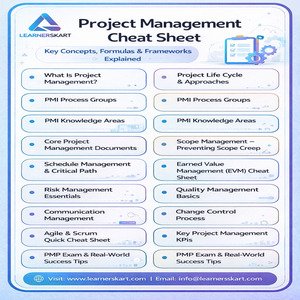
Project Management Cheat Sheet: Key Concepts, Formulas & Frameworks Explained
-
January 23, 2026
Project management can feel complex—multiple processes, formulas, methodologies, frameworks, and stakeholder expectations all competing for your attention. Whether you’re preparing for the PMP® exam, managing real-world projects, or building a high-performing PMO, having a single, reliable reference can make all the difference.
This Project Management Cheat Sheet brings together the most important concepts, formulas, frameworks, and best practices you need—clearly explained and easy to revise. Bookmark this guide or save it as your go-to reference for both exam success and practical execution.
What Is Project Management?
Project Management is the application of knowledge, skills, tools, and techniques to project activities to meet project requirements and deliver value to stakeholders.
Key Characteristics of a Project
-
Temporary (defined start and end)
-
Creates a unique product, service, or result
-
Progressively elaborated
-
Constrained by scope, schedule, cost, quality, risk, and resources
Project vs Program vs Portfolio
-
Project: A single initiative with specific deliverables
-
Program: Multiple related projects managed together for benefits
-
Portfolio: Projects and programs aligned to organizational strategy
Project Life Cycle amp; Delivery Approaches
Choosing the right project life cycle directly impacts success.
Common Project Life Cycles
-
Predictive (Waterfall): Fixed scope, sequential phases
-
Iterative: Repeated cycles with refinement
-
Incremental: Value delivered in parts
-
Agile / Adaptive: Flexible scope, frequent feedback
-
Hybrid: Combination of predictive and agile
👉 PMI strongly emphasizes tailoring—select the approach based on uncertainty, risk, and stakeholder needs.
PMI Process Groups Explained
PMI defines five high-level process groups that interact throughout the project:
-
Initiating – Define the project and gain authorization
-
Planning – Establish scope, schedule, cost, and strategy
-
Executing – Perform work and manage teams
-
Monitoring amp; Controlling – Track performance and manage changes
-
Closing – Finalize deliverables and document lessons learned
PMI Knowledge Areas (Traditional Foundation)
Although the PMP® exam now focuses on domains, the 10 Knowledge Areas remain essential for understanding:
-
Integration Management
-
Scope Management
-
Schedule Management
-
Cost Management
-
Quality Management
-
Resource Management
-
Communications Management
-
Risk Management
-
Procurement Management
-
Stakeholder Management
Core Project Management Documents
Successful projects rely on clear and controlled documentation:
-
Project Charter – Official project authorization
-
Project Management Plan – Execution and control strategy
-
Scope Statement – What’s included and excluded
-
Work Breakdown Structure (WBS) – Deliverable decomposition
-
Schedule Baseline – Approved timeline
-
Cost Baseline – Approved budget
-
Risk Register – Identified risks and responses
-
Stakeholder Register – Stakeholder influence and interests
-
Communication Plan – Who receives what, when, and how
Scope Management: Preventing Scope Creep
Scope management ensures the project delivers exactly what was approved—nothing more, nothing less.
Key Scope Processes
-
Collect Requirements
-
Define Scope
-
Create WBS
-
Validate Scope (formal acceptance)
-
Control Scope (change management)
Best Practice: Always refer to the scope baseline before accepting new requests.
Schedule Management amp; Critical Path
Key Concepts
-
Activity: A unit of work
-
Milestone: Significant event
-
Critical Path: Longest path with zero float
Important Formulas
-
Float (Slack) = LS − ES or LF − EF
-
PERT Estimate = (O + 4M + P) / 6
📌 Any delay on the critical path delays the entire project.
Earned Value Management (EVM) Cheat Sheet
EVM integrates scope, schedule, and cost to measure performance.
Key Terms
-
PV (Planned Value) – Budgeted work scheduled
-
EV (Earned Value) – Budgeted work completed
-
AC (Actual Cost) – Actual cost incurred
Essential Formulas
-
CV = EV − AC
-
SV = EV − PV
-
CPI = EV / AC
-
SPI = EV / PV
-
EAC = BAC / CPI
Interpretation
-
CPI or SPI > 1 → Good performance
-
CPI or SPI < 1 → Poor performance
Risk Management Essentials
A risk is an uncertain event that can positively or negatively impact project objectives.
Risk Response Strategies
Threats: Avoid • Mitigate • Transfer • Accept
Opportunities: Exploit • Enhance • Share • Accept
Common Risk Tools
-
Probability amp; Impact Matrix
-
Expected Monetary Value (EMV)
-
Monte Carlo Simulation
Quality Management Basics
Quality means fitness for use and conformance to requirements.
Cost of Quality (COQ)
-
Prevention Costs
-
Appraisal Costs
-
Failure Costs (Internal amp; External)
Quality Tools
-
Pareto Chart
-
Fishbone (Ishikawa) Diagram
-
Control Charts
-
Histograms
-
Check Sheets
👉 Prevention is always cheaper than correction.
Communication Management
Poor communication is one of the top causes of project failure.
Communication Channels Formula
Channels = n(n − 1) / 2
Best Practices
-
Tailor communication to stakeholders
-
Keep messages simple and clear
-
Use the right medium at the right time
Stakeholder Management
Stakeholders can make—or break—a project.
Key Steps
-
Identify stakeholders early
-
Analyze power, interest, and influence
-
Plan engagement strategies
-
Manage expectations continuously
📌 Engage stakeholders—don’t just inform them.
Change Control Process
Uncontrolled changes lead to scope creep and failure.
Standard Change Flow
-
Submit change request
-
Analyze impact (scope, time, cost, risk)
-
Review by Change Control Board (CCB)
-
Approve or reject
-
Update baselines and documents
Agile amp; Scrum Quick Cheat Sheet
Agile Values
-
Individuals over processes
-
Working product over documentation
-
Customer collaboration over contracts
-
Responding to change over rigid plans
Scrum Roles
-
Product Owner
-
Scrum Master
-
Development Team
Scrum Artifacts amp; Events
-
Product Backlog, Sprint Backlog, Increment
-
Sprint, Daily Scrum, Review, Retrospective
Key Project Management KPIs
-
Schedule Variance (SV)
-
Cost Variance (CV)
-
CPI amp; SPI
-
Risk Exposure
-
Defect Density
-
Stakeholder Satisfaction
Tracking the right KPIs enables proactive decision-making.
PMP Exam amp; Real-World Success Tips
-
Think servant leadership, not command-and-control
-
Focus on business value delivery
-
Prevent issues instead of escalating late
-
Engage stakeholders continuously
-
Always tailor processes to the environment
Final Thoughts
This Project Management Cheat Sheet is designed to be your single source of truth—whether you’re preparing for the PMP® exam, managing complex projects, or strengthening your PMO capabilities.
Save it, share it with your team, or convert it into a printable PDF for quick revision.
About Learnerskart
Learnerskart provides industry-recognized certification training and exam assistance for:
-
PMP® amp; CAPM®
-
Agile amp; Scrum
-
Lean Six Sigma
-
ITIL®
-
Digital Marketing
🌐 Visit: learnerskart.com | #x1f4e7; Email: info@learnerskart.com
✔️ Follow us for PM tips amp; career insights: https://lnkd.in/gYB4Dw4K
Tags:
agile vs waterfallEarned Value ManagementPMI knowledge areasPMI process groupsPMP exam preparationpmp formulasPMP Study GuideProject Management BasicsProject Management Best Practicesproject management cheat sheetproject management frameworksproject management KPIsProject Scheduling TechniquesRisk Management in ProjectsScope Creep Preventionscrum project management
You May Also Like

-
Jun 3, 2026
In today’s fast-paced and highly competitive business environment, organizations are constantly striving to achieve strategic goals, improve operational efficiency, and...
-
Jun 2, 2026
In many organizations, project management is often associated with schedules, trackers, dashboards, status reports, and governance meetings. While these tools...
-
May 8, 2026
Managing projects today is more complicated than ever. Project managers are expected to track schedules, budgets, resources, risks, issues, deadlines,...
-
May 7, 2026
Breaking into project management—or leveling up within it—doesn’t just depend on theory. It’s about how effectively you plan, collaborate, track,...
Sign up to receive our latest updates
Company
Support
Service Offerings
Special Offers
Get in touch
India
Call us directly?
+91-984-459-1589
Address
Learnerskart Solutions Pvt Ltd
4th floor, No: 207/189, 9th Main Rd, 6th Sector,
HSR Layout, Bengaluru, Karnataka 560102
info@learnerskart.com
USA
Call us directly?
+1 (307)-998-3816
Address
Learnerskart Americas LLC
30 N Gould St Ste R
Sheridan, WY 82801
info@learnerskart.com
Quick Contact
Trending Categories
Disclaimer
“PMI®”, “PMBOK®”, “PMP®”, “CAPM®” and “PMI-ACP®” are registered marks of the Project Management Institute, Inc.
ITIL® and PRINCE2® are registered trade marks of AXELOS Limited, used under permission of AXELOS Limited. All rights reserved.
“CSM”, “CST” are Registered Trade Marks of The Scrum Alliance, USA.
