
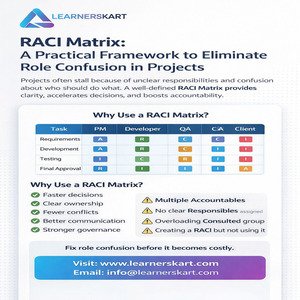
RACI Matrix: A Practical Framework to Eliminate Role Confusion in Projects
-
February 25, 2026
In many projects, delays are not caused by lack of skill or technology — they are caused by unclear roles and responsibilities. When team members are unsure about who should make decisions, who should execute tasks, or who should be informed, projects slow down and confusion increases.
One of the simplest and most effective tools to eliminate this confusion is the RACI Matrix — a practical framework that clarifies ownership and improves accountability.
This article explains what the RACI Matrix is, why it matters, how to create one, and how to use it effectively in real-world projects.
What is a RACI Matrix?
The Project Management Institute describes RACI as a responsibility assignment tool used to define roles and responsibilities for project activities.
RACI stands for:
-
R – Responsible
-
A – Accountable
-
C – Consulted
-
I – Informed
A RACI Matrix is a simple table that maps project tasks against project roles to clearly define ownership.
It answers four essential questions:
-
Who will do the work?
-
Who owns the result?
-
Who needs to provide input?
-
Who needs updates?
Without clear answers to these questions, projects often experience delays and miscommunication.
Why Role Clarity Matters in Projects
Many project problems originate from unclear ownership.
Typical symptoms include:
-
Decisions take too long
-
Tasks fall through the cracks
-
Multiple people assume others are responsible
-
Stakeholders complain about lack of updates
-
Teams duplicate work
Role confusion leads to:
-
Missed deadlines
-
Increased costs
-
Team frustration
-
Poor stakeholder satisfaction
A RACI Matrix prevents these problems by creating structured accountability.
Understanding the RACI Roles
1. Responsible (R)
The Responsible person or group performs the actual work.
They are the individuals who:
-
Execute tasks
-
Produce deliverables
-
Complete assigned activities
Key points:
-
There can be multiple Responsible roles
-
Responsible means #8220;doing the work”
Example:
-
Developer builds software
-
Engineer prepares drawings
-
Analyst creates reports
2. Accountable (A)
The Accountable person owns the outcome.
This person:
-
Approves the work
-
Makes decisions
-
Ensures completion
Key rule:
Each task should have only ONE Accountable person.
Multiple Accountables create confusion and slow decisions.
Typically, the Accountable role is:
-
Project Manager
-
Department Head
-
Product Owner
-
Sponsor
Accountable means ultimate ownership.
3. Consulted (C)
The Consulted role provides input and expertise.
These stakeholders:
-
Share knowledge
-
Review deliverables
-
Provide feedback
Communication is two-way.
Examples:
-
Subject matter experts
-
Architects
-
Legal teams
-
Quality specialists
Too many Consulted roles can slow progress.
4. Informed (I)
The Informed role receives updates.
These stakeholders:
-
Need visibility
-
Track progress
-
Stay aware
Communication is one-way.
Examples:
-
Senior management
-
Customers
-
Support teams
-
External partners
Informed stakeholders should not be overloaded with unnecessary details.
Example of a Simple RACI Matrix
| Task | Project Manager | Developer | QA | Client |
|---|---|---|---|---|
| Requirements | A | R | C | I |
| Development | A | R | I | I |
| Testing | I | C | R | I |
| Final Approval | R | I | I | A |
This table clearly shows:
-
Who does the work
-
Who approves
-
Who contributes
-
Who receives updates
Even a simple matrix like this can significantly improve project coordination.
Benefits of Using a RACI Matrix
1. Faster Decision-Making
When accountability is clear:
-
Decisions happen faster
-
Escalations reduce
-
Approvals are easier
No time is wasted finding the decision-maker.
2. Clear Ownership
Everyone knows:
-
What they own
-
What they don’t own
This prevents confusion and overlap.
3. Reduced Rework
Clear roles reduce:
-
Duplicate effort
-
Miscommunication
-
Incorrect assumptions
Teams execute correctly the first time.
4. Better Communication
Stakeholders receive:
-
Relevant updates
-
Timely information
-
Clear expectations
Communication becomes structured.
5. Stronger Project Governance
RACI supports:
-
PMO standards
-
Structured processes
-
Consistent delivery
It is widely used in mature organizations.
When Should You Create a RACI Matrix?
The best time is during project initiation or planning.
Ideal stages:
-
Project kickoff
-
Planning workshops
-
Scope definition
-
Stakeholder identification
Creating RACI early prevents future problems.
Late creation reduces effectiveness.
How to Create a RACI Matrix Step-by-Step
Step 1: Identify Tasks
List key project activities:
-
Requirements
-
Design
-
Development
-
Testing
-
Deployment
Avoid too much detail.
Focus on major deliverables.
Step 2: Identify Roles
List roles — not names.
Examples:
-
Project Manager
-
Engineer
-
QA
-
Client
-
Vendor
Role-based matrices scale better.
Step 3: Assign Responsibilities
Assign:
-
Responsible
-
Accountable
-
Consulted
-
Informed
Ensure:
-
Each task has one Accountable
-
Each task has at least one Responsible
Step 4: Validate with Stakeholders
Review with the team.
Confirm:
-
Everyone agrees
-
Responsibilities are realistic
-
No gaps exist
This step is critical.
Step 5: Publish and Use It
A RACI Matrix is useful only if it is used.
Share it:
-
In kickoff meetings
-
In project plans
-
In collaboration tools
Keep it visible.
Common Mistakes to Avoid
1. Multiple Accountables
Having multiple Accountables causes:
-
Decision delays
-
Conflicts
-
Confusion
Always assign one owner.
2. No Responsible Assigned
Without a Responsible role:
-
Work does not get done
-
Tasks are ignored
Every task needs execution ownership.
3. Too Many Consulted Roles
Excessive consultation causes:
-
Meeting overload
-
Slow decisions
Consult only necessary experts.
4. Too Many Informed Stakeholders
Too many updates lead to:
-
Information overload
-
Ignored emails
Inform only key stakeholders.
5. Creating RACI But Not Using It
This is the most common problem.
RACI must be:
-
Referenced in meetings
-
Used for decisions
-
Updated when needed
Otherwise it becomes useless.
Advanced Tips for Effective RACI Implementation
Keep It Simple
Complex matrices fail.
Use:
-
10–20 tasks
-
5–10 roles
Simplicity improves adoption.
Use Roles Instead of Names
Avoid:
John – Responsible
Sarah – Accountable
Use:
Project Manager – Accountable
This supports scalability.
Review Regularly
Projects change.
Update RACI when:
-
Scope changes
-
Team changes
-
New stakeholders join
Integrate with Project Plans
Link RACI with:
-
Project schedule
-
Deliverables
-
Governance model
Integration improves effectiveness.
RACI vs Other Responsibility Models
Other models include:
-
RASCI (adds Support)
-
DACI (Driver, Approver, Contributor, Informed)
-
RAPID (Decision-focused)
However, RACI remains the most widely used because:
-
Simple
-
Flexible
-
Easy to implement
Real-World Example
A software company faced delays in product releases.
Problems included:
-
Developers waiting for approvals
-
QA unsure about ownership
-
Stakeholders demanding updates
After implementing RACI:
-
Approval time reduced by 40%
-
Fewer conflicts occurred
-
Communication improved
Role clarity transformed project performance.
Conclusion
Project success depends on clarity.
When roles are unclear:
-
Work slows down
-
Decisions stall
-
Teams struggle
The RACI Matrix provides a simple and powerful solution.
By defining:
-
Who executes
-
Who owns
-
Who contributes
-
Who is informed
Organizations can eliminate confusion and improve delivery.
Structured accountability drives consistent results.
About LearnersKart
LearnersKart provides professional training and practical knowledge in project management and certification preparation.
🌐 Visit: learnerskart.com | #x1f4e7; Email: info@learnerskart.com
✔️ Follow us for PM tips amp; career insights: https://lnkd.in/gYB4Dw4K
Tags:
PMI FrameworkPMP Project ManagementProject accountabilityProject GovernanceProject Management Best Practicesproject management rolesProject Management Toolsproject planning toolsProject team rolesRACI frameworkRACI MatrixRACI matrix explainedRACI roles and responsibilitiesResponsibility assignment matrixStakeholder Management
You May Also Like

-
Jun 3, 2026
In today’s fast-paced and highly competitive business environment, organizations are constantly striving to achieve strategic goals, improve operational efficiency, and...
-
Jun 2, 2026
In many organizations, project management is often associated with schedules, trackers, dashboards, status reports, and governance meetings. While these tools...
-
May 8, 2026
Managing projects today is more complicated than ever. Project managers are expected to track schedules, budgets, resources, risks, issues, deadlines,...
-
May 7, 2026
Breaking into project management—or leveling up within it—doesn’t just depend on theory. It’s about how effectively you plan, collaborate, track,...
Sign up to receive our latest updates
Company
Support
Service Offerings
Special Offers
Get in touch
India
Call us directly?
+91-984-459-1589
Address
Learnerskart Solutions Pvt Ltd
4th floor, No: 207/189, 9th Main Rd, 6th Sector,
HSR Layout, Bengaluru, Karnataka 560102
info@learnerskart.com
USA
Call us directly?
+1 (307)-998-3816
Address
Learnerskart Americas LLC
30 N Gould St Ste R
Sheridan, WY 82801
info@learnerskart.com
Quick Contact
Trending Categories
Disclaimer
“PMI®”, “PMBOK®”, “PMP®”, “CAPM®” and “PMI-ACP®” are registered marks of the Project Management Institute, Inc.
ITIL® and PRINCE2® are registered trade marks of AXELOS Limited, used under permission of AXELOS Limited. All rights reserved.
“CSM”, “CST” are Registered Trade Marks of The Scrum Alliance, USA.
