
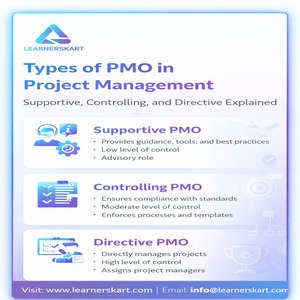
Types of PMO in Project Management: Supportive, Controlling, and Directive Explained
-
March 6, 2026
In today’s fast-paced business environment, organizations run multiple projects simultaneously to achieve strategic goals, improve operational efficiency, and stay competitive. Managing these projects effectively requires structure, governance, and standardized processes. This is where a Project Management Office (PMO) becomes essential.
A PMO acts as the central hub that guides how projects are managed within an organization. It ensures consistency, improves project performance, and aligns projects with organizational strategy. According to A Guide to the Project Management Body of Knowledge (PMBOK® Guide), widely used in preparation for Project Management Professional (PMP), PMOs are commonly categorized into three types based on their level of authority and control: Supportive PMO, Controlling PMO, and Directive PMO.
This article explains these three PMO types, their structure, roles, and responsibilities, and how organizations benefit from implementing a PMO.
What is a PMO in Project Management?
A Project Management Office (PMO) is a centralized organizational unit responsible for defining and maintaining project management standards. It provides the tools, methodologies, and governance required to ensure projects are delivered successfully.
Rather than managing individual projects alone, the PMO focuses on improving the overall project management capability of the organization.
Core Functions of a PMO
A PMO typically performs several key functions, including:
-
Developing standardized project management methodologies
-
Providing project templates, documentation, and tools
-
Monitoring project performance and progress
-
Supporting project managers with training and guidance
-
Managing resource allocation across projects
-
Ensuring projects align with organizational strategy
By establishing consistent practices, the PMO helps organizations reduce risks, improve efficiency, and achieve better project outcomes.
Types of PMO in Project Management
PMOs are generally classified based on the degree of control they have over project activities. The three widely recognized types include:
-
Supportive PMO
-
Controlling PMO
-
Directive PMO
Each type serves a different purpose depending on the organization’s maturity, governance needs, and project complexity.
1. Supportive PMO
A Supportive PMO acts primarily as an advisory body. It provides project teams with resources, templates, and best practices but does not enforce strict rules or governance.
This type of PMO focuses on support and knowledge sharing rather than control.
Key Characteristics
-
Provides project management templates and guidelines
-
Offers training and mentoring for project teams
-
Maintains a knowledge repository of project documentation
-
Encourages adoption of best practices
Level of Authority
Low
When Organizations Use Supportive PMO
Supportive PMOs are commonly found in organizations where project managers already possess strong experience and independence. In such environments, the PMO acts as a facilitator rather than a controller.
Advantages
-
Encourages collaboration and continuous learning
-
Provides flexibility for project teams
-
Promotes sharing of knowledge and experience
This model works well in organizations with a collaborative culture and mature project teams.
2. Controlling PMO
A Controlling PMO introduces a higher level of governance by ensuring that project teams follow established processes and methodologies.
While it still provides guidance and support, it also requires compliance with defined project management standards.
Key Characteristics
-
Enforces project management frameworks and processes
-
Requires teams to use approved templates and reporting formats
-
Conducts periodic project audits and reviews
-
Monitors compliance with governance policies
Level of Authority
Moderate
Organizations that follow structured frameworks such as PRINCE2 often implement a Controlling PMO to ensure standardized execution.
Advantages
-
Improves consistency across projects
-
Enhances governance and accountability
-
Reduces project risks through standardized procedures
This model is suitable for organizations that require structured project management without completely centralizing control.
3. Directive PMO
A Directive PMO has the highest level of authority within the organization’s project management framework. Instead of simply advising or enforcing standards, it directly manages projects and assigns project managers.
Key Characteristics
-
Directly manages and oversees projects
-
Assigns project managers to projects
-
Controls project budgets and resources
-
Monitors execution and performance closely
Level of Authority
High
When Organizations Use Directive PMO
Directive PMOs are commonly used in large organizations with complex project portfolios where centralized management improves efficiency and alignment with business goals.
Advantages
-
Strong governance and oversight
-
Better coordination of resources
-
Increased project success rates
This structure is particularly useful when organizations want full control over project execution and performance.
Comparison of the Three Types of PMO
| PMO Type | Level of Control | Primary Role |
|---|---|---|
| Supportive PMO | Low | Provides guidance, tools, and best practices |
| Controlling PMO | Moderate | Ensures compliance with standards |
| Directive PMO | High | Directly manages projects |
Understanding these distinctions helps organizations select the PMO structure that aligns with their governance needs and operational strategy.
PMO Structure in Organizations
The internal structure of a PMO varies depending on the size and complexity of the organization. A well-structured PMO ensures effective coordination between project teams and executive leadership.
Typical PMO Organizational Structure
A typical PMO July include the following roles:
PMO Director or Head of PMO
Responsible for leading the PMO and ensuring that project management practices align with the organization’s strategic objectives.
Program Managers
Oversee multiple related projects and ensure they deliver the intended business benefits.
Project Managers
Responsible for planning, executing, and delivering individual projects within scope, budget, and timeline.
PMO Analysts or Coordinators
Support project managers by maintaining documentation, preparing reports, and monitoring project performance.
Project Support Staff
Provide administrative assistance and operational support for project teams.
A structured PMO hierarchy enables organizations to manage projects efficiently while maintaining strong governance.
Roles and Responsibilities of a PMO
The Project Management Office plays a crucial role in improving project governance and organizational efficiency.
1. Establishing Standardized Methodologies
PMOs create consistent project management frameworks, templates, and guidelines that all project teams can follow.
2. Governance and Compliance
They ensure projects comply with organizational policies, industry standards, and project management methodologies.
3. Performance Monitoring and Reporting
PMOs track project progress and provide regular performance reports to stakeholders and leadership teams.
4. Resource Coordination
They help allocate resources effectively across multiple projects to maximize productivity.
5. Training and Capability Development
PMOs provide training programs, mentoring, and knowledge-sharing initiatives to strengthen project management skills.
6. Risk and Issue Management Support
PMOs assist project teams in identifying risks, mitigating issues, and maintaining project stability.
7. Strategic Alignment
One of the most critical responsibilities of the PMO is ensuring that projects contribute to the organization’s long-term strategic objectives.
Benefits of Implementing a PMO
Organizations that establish a strong PMO often experience significant improvements in project outcomes.
Key Benefits
-
Greater consistency in project management practices
-
Higher project success rates
-
Improved resource utilization
-
Enhanced transparency and reporting
-
Better alignment between projects and business strategy
By providing governance and support, the PMO helps organizations deliver projects more efficiently and with reduced risk.
Why PMO Knowledge Is Important for Project Managers
Understanding PMO structures and functions is essential for professionals pursuing careers in project management. It helps project managers work effectively within organizational frameworks and contribute to strategic initiatives.
Knowledge of PMO concepts is also valuable for individuals preparing for certifications such as Project Management Professional (PMP) and PRINCE2, where governance, structure, and project oversight are key learning areas.
Conclusion
A Project Management Office (PMO) is a critical component of modern organizations that manage multiple projects and programs. It provides governance, standardization, and strategic alignment for project activities.
The three primary types of PMO—Supportive, Controlling, and Directive—differ in the level of authority they hold over project management processes. While Supportive PMOs focus on guidance, Controlling PMOs enforce standards, and Directive PMOs take direct responsibility for project execution.
Choosing the right PMO structure helps organizations improve project success rates, optimize resources, and achieve strategic objectives.
Learn Professional Project Management Certifications
Professionals who want to advance their careers in project management can benefit from globally recognized certifications such as Project Management Professional (PMP) and PRINCE2.
Learnerskart provides professional certification training and exam assistance designed to help working professionals build strong project management skills.
🌐 Visit: learnerskart.com | #x1f4e7; Email: info@learnerskart.com
✔️ Follow us for PM tips amp; career insights: https://lnkd.in/gYB4Dw4K
These programs help professionals gain industry-recognized credentials and accelerate their career growth in project management. #x1f680;
Tags:
You May Also Like

-
Jun 3, 2026
In today’s fast-paced and highly competitive business environment, organizations are constantly striving to achieve strategic goals, improve operational efficiency, and...
-
Jun 2, 2026
In many organizations, project management is often associated with schedules, trackers, dashboards, status reports, and governance meetings. While these tools...
-
May 8, 2026
Managing projects today is more complicated than ever. Project managers are expected to track schedules, budgets, resources, risks, issues, deadlines,...
-
May 7, 2026
Breaking into project management—or leveling up within it—doesn’t just depend on theory. It’s about how effectively you plan, collaborate, track,...
Sign up to receive our latest updates
Company
Support
Service Offerings
Special Offers
Get in touch
India
Call us directly?
+91-984-459-1589
Address
Learnerskart Solutions Pvt Ltd
4th floor, No: 207/189, 9th Main Rd, 6th Sector,
HSR Layout, Bengaluru, Karnataka 560102
info@learnerskart.com
USA
Call us directly?
+1 (307)-998-3816
Address
Learnerskart Americas LLC
30 N Gould St Ste R
Sheridan, WY 82801
info@learnerskart.com
Quick Contact
Trending Categories
Disclaimer
“PMI®”, “PMBOK®”, “PMP®”, “CAPM®” and “PMI-ACP®” are registered marks of the Project Management Institute, Inc.
ITIL® and PRINCE2® are registered trade marks of AXELOS Limited, used under permission of AXELOS Limited. All rights reserved.
“CSM”, “CST” are Registered Trade Marks of The Scrum Alliance, USA.
