
The Invisible Power of a Great Project Manager
-
March 17, 2026
In many organisations, the role of a Project Manager is often misunderstood. Some people believe that a great Project Manager is the loudest voice in meetings, constantly asking for updates and pushing the team for results.
However, the reality is quite different.
In fact, if your Project Manager feels “invisible,” it often means they are performing their role exceptionally well.
Great Project Managers work quietly behind the scenes. They remove obstacles, manage expectations, and ensure that teams can focus on delivering results without unnecessary disruptions.
Their work May not always be visible, but their impact on project success is immense.
Understanding the Real Role of a Project Manager
A Project Manager is responsible for planning, executing, and delivering projects successfully. Their role involves coordinating multiple stakeholders, managing risks, and ensuring that project objectives align with organizational goals.
Modern project management practices are widely guided by frameworks developed by the Project Management Institute, the global authority for project management standards.
A skilled Project Manager ensures that every aspect of a project works together efficiently.
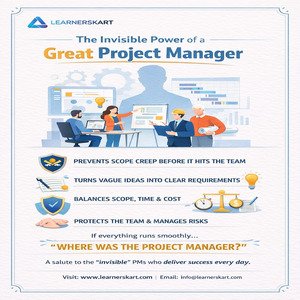
Preventing Scope Creep Before It Reaches the Team
One of the biggest challenges in project management is scope creep. This occurs when new requirements or changes are continuously added to a project without proper control.
Stakeholders May request additional features or modifications during the project lifecycle. If these changes are not managed properly, they can disrupt timelines and increase costs.
A strong Project Manager carefully evaluates these requests and ensures that only approved and necessary changes are implemented.
By doing this, they protect the team from unnecessary pressure and keep the project aligned with its original goals.
Turning Vague Ideas into Clear Requirements
Stakeholders often express their needs in broad or unclear terms. Translating these ideas into clear and actionable requirements is one of the most important responsibilities of a Project Manager.
A great Project Manager ensures that:
-
Project goals are clearly defined
-
Requirements are well documented
-
Teams understand what needs to be delivered
This clarity helps teams avoid confusion and focus on delivering high-quality results.
Balancing Scope, Time, and Cost
Every project must balance three critical constraints:
-
Scope
-
Schedule
-
Budget
This balance is often referred to as the Project Management Triangle.
Managing these constraints requires strong planning and decision-making skills. A good Project Manager constantly evaluates priorities and ensures that the project remains realistic and achievable.
By maintaining this balance, they help organizations avoid delays, budget overruns, and quality issues.
Protecting the Team from Distractions
One of the most valuable yet invisible contributions of a Project Manager is protecting the team from unnecessary distractions.
Project teams often face pressure from multiple stakeholders, changing requirements, and unexpected challenges. A skilled Project Manager acts as a shield, managing communication and resolving conflicts before they impact the team.
This allows team members to focus on their work without constant interruptions.
Managing Risks and Uncertainty
Every project involves risks. These risks can include technical challenges, resource limitations, schedule delays, or external factors.
A great Project Manager identifies potential risks early and develops strategies to mitigate them.
By proactively managing risks, they reduce the likelihood of project failure and ensure smoother project execution.
Ensuring Successful Project Delivery
At the end of the day, the success of any project depends on coordination, communication, and effective leadership.
Project Managers ensure that:
-
Teams collaborate effectively
-
Stakeholders remain informed
-
Project milestones are achieved
-
Deliverables meet quality standards
When everything runs smoothly, the effort of the Project Manager often goes unnoticed.
But when something goes wrong, the first question people ask is:
“Where was the Project Manager?”
This highlights how critical their role truly is.
Appreciating the Invisible Leaders
Great Project Managers May not always seek recognition, but they play a vital role in ensuring that projects are delivered successfully.
Their leadership, planning skills, and ability to solve complex problems help organizations achieve their business objectives.
So here’s a salute to the “invisible” Project Managers who quietly safeguard delivery, outcomes, and return on investment every day.
Advance Your Career in Project Management
If you want to build a successful career in project management, earning a globally recognized certification like the Project Management Professional (PMP) can significantly enhance your skills and professional credibility.
Professional certification helps you gain structured knowledge, practical project management techniques, and global recognition in the industry.
About Learnerskart
Learnerskart provides professional certification training and exam assistance for globally recognized career-oriented certifications. The platform supports working professionals, job seekers, and aspiring leaders in enhancing their skills and achieving career growth.
Learnerskart offers training programs for several in-demand certifications including:
-
PMP® (Project Management Professional)
-
CAPM®
-
Lean Six Sigma
-
PRINCE2®
-
ITIL®
-
Business Analysis Certifications
Our training programs are designed to help professionals gain industry-relevant knowledge and achieve certification success.
🌐 Visit: www.learnerskart.com | #x1f4e7; Email: info@learnerskart.com
✔️ Follow us for PM tips amp; career insights: https://lnkd.in/gYB4Dw4K
Tags:
importance of project managerinvisible power of project managerPMP certificationproject leadershipProject ManagementProject Management Best Practicesproject management careerproject management leadershipproject management skillsproject management successProject Management Trainingproject manager responsibilitiesProject Manager RoleRisk ManagementScope Management
You May Also Like
-
May 8, 2026
Managing projects today is more complicated than ever. Project managers are expected to track schedules, budgets, resources, risks, issues, deadlines,...

-
May 7, 2026
Breaking into project management—or leveling up within it—doesn’t just depend on theory. It’s about how effectively you plan, collaborate, track,...

-
May 6, 2026
In today’s fast-paced project environments, success isn’t driven by tools, dashboards, or methodologies alone. While frameworks like Agile or predictive...

-
May 5, 2026
Every project has deadlines, budgets, and deliverables—but the real driving force behind success is people. No matter how strong your...
Sign up to receive our latest updates
Company
Support
Service Offerings
Special Offers
Get in touch
India
Call us directly?
+91-984-459-1589
Address
Learnerskart Solutions Pvt Ltd
4th floor, No: 207/189, 9th Main Rd, 6th Sector,
HSR Layout, Bengaluru, Karnataka 560102
info@learnerskart.com
USA
Call us directly?
+1 (307)-998-3816
Address
Learnerskart Americas LLC
30 N Gould St Ste R
Sheridan, WY 82801
info@learnerskart.com
Quick Contact
Trending Categories
Disclaimer
“PMI®”, “PMBOK®”, “PMP®”, “CAPM®” and “PMI-ACP®” are registered marks of the Project Management Institute, Inc.
ITIL® and PRINCE2® are registered trade marks of AXELOS Limited, used under permission of AXELOS Limited. All rights reserved.
“CSM”, “CST” are Registered Trade Marks of The Scrum Alliance, USA.
