Project Manager vs Program Manager: What’s the Real Difference? | Learnerskart
-
October 29, 2025
In the world of project management, two roles often create confusion: Project Manager and Program Manager.
While they sound similar, their responsibilities, focus, and goals differ greatly. Understanding the distinction between the two is key to ensuring projects align with your organization’s strategy.
Who is a Project Manager?
A Project Manager (PM) is responsible for the execution of a single project.
They oversee day-to-day activities, manage timelines, monitor budgets, and ensure deliverables meet quality standards.
Their role revolves around turning strategy into action.
Key Responsibilities:
-
Define project scope and objectives
-
Create detailed project plans and schedules
-
Coordinate resources and manage the project team
-
Monitor risks, issues, and changes
-
Deliver the project on time and within budget
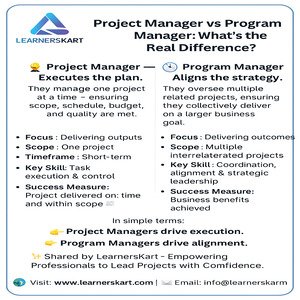
Primary Focus: Delivering outputs — the tangible results of a specific project.
Who is a Program Manager?
A Program Manager oversees multiple related projects that contribute to a common strategic goal.
Their focus extends beyond execution — they ensure alignment between projects, manage dependencies, and ensure that all projects collectively deliver business outcomes.
Key Responsibilities:
-
Define program goals aligned with business strategy
-
Oversee multiple project managers
-
Manage interdependencies and cross-functional collaboration
-
Ensure benefits realization and stakeholder satisfaction
-
Align all project outcomes with organizational objectives
Primary Focus: Delivering outcomes — ensuring multiple projects work together to achieve strategic success.
Key Differences at a Glance
| Aspect | Project Manager | Program Manager |
|---|---|---|
| Focus | Delivering outputs | Delivering outcomes |
| Scope | One specific project | Multiple related projects |
| Timeframe | Short-term | Long-term |
| Key Skill | Execution and control | Strategic alignment and leadership |
| Success Measure | Project delivered on time and within scope | Business benefits achieved |
In Simple Terms
➡️ Project Managers drive execution — they make things happen.
➡️ Program Managers drive alignment — they make sure it all happens for the right reason.
Both roles are vital to business success — one ensures efficiency, the other ensures effectiveness.
Conclusion
Whether you’re managing a single project or overseeing multiple initiatives, both roles demand leadership, communication, and strategic thinking.
Organizations that clearly define these roles achieve better coordination, smoother execution, and greater overall impact.
✨ Shared by LearnersKart
Empowering Professionals to Lead Projects with Confidence.
🌐 Visit: learnerskart.com | #x1f4e7; Email: info@learnerskart.com
✔️ Follow us for more project management tips amp; career insights! https://lnkd.in/gYB4Dw4K
Tags:
You May Also Like

-
Jun 3, 2026
In today’s fast-paced and highly competitive business environment, organizations are constantly striving to achieve strategic goals, improve operational efficiency, and...
-
Jun 2, 2026
In many organizations, project management is often associated with schedules, trackers, dashboards, status reports, and governance meetings. While these tools...
-
May 8, 2026
Managing projects today is more complicated than ever. Project managers are expected to track schedules, budgets, resources, risks, issues, deadlines,...
-
May 7, 2026
Breaking into project management—or leveling up within it—doesn’t just depend on theory. It’s about how effectively you plan, collaborate, track,...
Sign up to receive our latest updates
Company
Support
Service Offerings
Special Offers
Get in touch
India
Call us directly?
+91-984-459-1589
Address
Learnerskart Solutions Pvt Ltd
4th floor, No: 207/189, 9th Main Rd, 6th Sector,
HSR Layout, Bengaluru, Karnataka 560102
info@learnerskart.com
USA
Call us directly?
+1 (307)-998-3816
Address
Learnerskart Americas LLC
30 N Gould St Ste R
Sheridan, WY 82801
info@learnerskart.com
Quick Contact
Trending Categories
Disclaimer
“PMI®”, “PMBOK®”, “PMP®”, “CAPM®” and “PMI-ACP®” are registered marks of the Project Management Institute, Inc.
ITIL® and PRINCE2® are registered trade marks of AXELOS Limited, used under permission of AXELOS Limited. All rights reserved.
“CSM”, “CST” are Registered Trade Marks of The Scrum Alliance, USA.
