
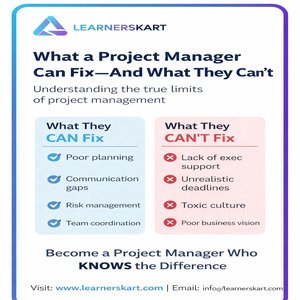
What a Project Manager Can Fix, and What They Can’t
-
March 30, 2026
Understanding the Real Power (and Limits) of Project Management
Project managers are often seen as problem solvers who can “fix anything.” Deadlines slipping? Call the PM. Team conflict? PM will handle it. Stakeholders unhappy? PM will manage.
But here’s the truth:
👉 A great project manager knows not just what they can fix—but also what they cannot.
Understanding this distinction is what separates an average project manager from a strategic leader.
What a Project Manager CAN Fix
These are areas where a project manager has direct influence and can drive real impact.
1. Poor Planning
A weak plan leads to confusion, delays, and cost overruns.
A skilled project manager can:
- Define clear scope and deliverables
- Break down work into manageable tasks
- Create realistic schedules
- Align resources effectively
📌 Impact: Better predictability and execution
2. Communication Gaps
Miscommunication is one of the biggest reasons projects fail.
A project manager can:
- Establish clear communication channels
- Ensure regular updates and reporting
- Align stakeholders and teams
- Avoid misunderstandings
📌 Impact: Transparency and smoother collaboration
3. Risk Identification amp; Management
Risks are unavoidable—but unmanaged risks are dangerous.
A project manager can:
- Identify potential risks early
- Analyze impact and probability
- Create mitigation and contingency plans
- Monitor risks continuously
📌 Impact: Fewer surprises and better control
4. Team Coordination
Even skilled teams fail without coordination.
A project manager ensures:
- Clear roles and responsibilities
- Task alignment across teams
- Conflict resolution
- Motivation and accountability
📌 Impact: Higher productivity and team efficiency
5. Process Improvements
Inefficient processes slow everything down.
A project manager can:
- Identify bottlenecks
- Introduce Agile or hybrid practices
- Improve workflows
- Optimize delivery cycles
📌 Impact: Faster and more efficient project delivery
What a Project Manager CANNOT Fix
This is where many organizations misunderstand the role.
1. Lack of Executive Support
If leadership is not aligned or supportive:
- Decisions get delayed
- Priorities keep changing
- Authority becomes unclear
❌ A PM cannot force executive commitment.
📌 Reality: This requires leadership alignment, not project management.
2. Unrealistic Deadlines (Imposed from Top)
When deadlines are politically or emotionally driven:
- No buffer for risks
- No realistic planning
- Pressure on teams
❌ A PM can highlight risks—but cannot always change imposed deadlines.
📌 Reality: Negotiation is possible, but not always successful.
3. Toxic Organizational Culture
If the environment includes:
- Blame games
- Lack of trust
- Poor collaboration
- Fear-based management
❌ A PM cannot transform company culture alone.
📌 Reality: Culture change must come from leadership.
4. Poor Business Vision or Strategy
If the project itself lacks clarity or purpose:
- Requirements keep changing
- Stakeholders are confused
- Value delivery becomes unclear
❌ A PM executes strategy—they don’t define it.
📌 Reality: Business leaders must provide direction.
5. Resource Constraints Beyond Control
Sometimes:
- Teams are understaffed
- Skills are missing
- Budgets are limited
❌ A PM can escalate—but cannot create resources out of thin air.
📌 Reality: Organizational decisions drive resourcing.
The Real Role of a Project Manager
A project manager is not a magician.
They are: #x2714; A facilitator of success
✔ A bridge between teams and stakeholders
✔ A risk manager and planner
✔ A decision enabler—not always the decision maker
The Key Skill: Knowing the Difference
The most successful project managers:
✅ Focus energy on what they can control
✅ Escalate what they cannot control
✅ Communicate clearly and proactively
✅ Set realistic expectations early
Why This Matters More Than Ever
In today’s fast-paced, high-pressure environments:
- Expectations from PMs are increasing
- Projects are becoming more complex
- Stakeholders demand faster delivery
👉 Knowing your boundaries is not weakness—it’s strategic leadership.
Final Thoughts
A project manager’s true strength lies not in “fixing everything,” but in:
✔ Fixing what’s within control
✔ Influencing what’s possible
✔ Escalating what’s beyond reach
💡 Because success in project management is not about control—it’s about clarity.
If you want to become a project manager who understands not just tools—but real-world challenges:
👉 Learn practical, industry-focused project management skills
👉 Master PMP, Agile, and leadership techniques
👉 Build confidence to handle real project scenarios
🌐 Visit: www.learnerskart.com | #x1f4e7; Email: info@learnerskart.com
✔️ Follow us for PM tips amp; career insights: https://lnkd.in/gYB4Dw4K
Tags:
leadership in project managementPM responsibilities vs authorityPMP concepts real worldProject Management Challengesproject management limitationsProject Manager Roles and Responsibilitiesproject manager skillsRisk Management in Projectsrole of project managerStakeholder Managementwhat project managers can control
You May Also Like

-
Jun 3, 2026
In today’s fast-paced and highly competitive business environment, organizations are constantly striving to achieve strategic goals, improve operational efficiency, and...
-
Jun 2, 2026
In many organizations, project management is often associated with schedules, trackers, dashboards, status reports, and governance meetings. While these tools...
-
May 8, 2026
Managing projects today is more complicated than ever. Project managers are expected to track schedules, budgets, resources, risks, issues, deadlines,...

-
May 7, 2026
Breaking into project management—or leveling up within it—doesn’t just depend on theory. It’s about how effectively you plan, collaborate, track,...
Sign up to receive our latest updates
Company
Support
Service Offerings
Special Offers
Get in touch
India
Call us directly?
+91-984-459-1589
Address
Learnerskart Solutions Pvt Ltd
4th floor, No: 207/189, 9th Main Rd, 6th Sector,
HSR Layout, Bengaluru, Karnataka 560102
info@learnerskart.com
USA
Call us directly?
+1 (307)-998-3816
Address
Learnerskart Americas LLC
30 N Gould St Ste R
Sheridan, WY 82801
info@learnerskart.com
Quick Contact
Trending Categories
Disclaimer
“PMI®”, “PMBOK®”, “PMP®”, “CAPM®” and “PMI-ACP®” are registered marks of the Project Management Institute, Inc.
ITIL® and PRINCE2® are registered trade marks of AXELOS Limited, used under permission of AXELOS Limited. All rights reserved.
“CSM”, “CST” are Registered Trade Marks of The Scrum Alliance, USA.
