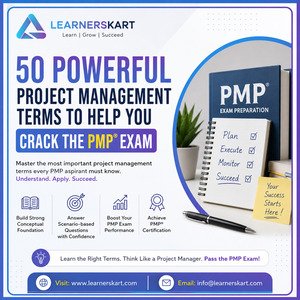
50 Powerful Project Management Terms to Help You Crack the PMP Exam
-
May 4, 2026
If you’re preparing for the PMP exam by the Project Management Institute, you’ve probably realized one thing:
👉 It’s not just about studying—it’s about understanding the language of project management.
The PMP exam is heavily scenario-based. That means if you don’t clearly understand key terms, you’ll struggle to choose the correct answer—even if you “feel” it’s right.
This guide simplifies 50 powerful project management terms that will help you:
- Understand PMP concepts faster
- Answer situational questions confidently
- Improve your chances of passing on the first attempt
Let’s break it down in a simple, practical way.
🔹 Integration Management (The Big Picture)
1. Project Charter
The official document that authorizes the project and gives the project manager authority.
2. Project Management Plan
Your master blueprint—how the project will be executed, monitored, and closed.
3. Change Request
Any proposal to modify scope, schedule, or cost.
4. Integrated Change Control
Formal process to review and approve/reject changes.
5. Lessons Learned
Knowledge gained during the project to improve future performance.
🔹 Scope Management (What’s Included)
6. Scope
Defines what is included (and excluded) in the project.
7. Scope Baseline
Approved version of the project scope.
8. WBS (Work Breakdown Structure)
Breaking down work into manageable pieces.
9. Scope Creep
Uncontrolled expansion of scope without approval.
10. Deliverables
Tangible or intangible outputs produced.
🔹 Schedule Management (Time Control)
11. Activity List
All tasks needed to complete the project.
12. Milestone
Significant checkpoint in the project timeline.
13. Critical Path
The longest path that determines project duration.
14. Float (Slack)
Time a task can be delayed without impacting deadlines.
15. Schedule Baseline
Approved project schedule.
🔹 Cost Management (Money Matters #x1f4b0;)
16. Cost Baseline
Approved project budget.
17. Planned Value (PV)
Budgeted cost of scheduled work.
18. Earned Value (EV)
Value of work actually completed.
19. Actual Cost (AC)
Actual money spent.
20. Cost Performance Index (CPI)
Measures cost efficiency (EV ÷ AC).
21. Schedule Performance Index (SPI)
Measures schedule efficiency (EV ÷ PV).
🔹 Quality Management (Doing It Right)
22. Quality Assurance
Process-focused—ensures correct processes are used.
23. Quality Control
Product-focused—checks output quality.
24. Cost of Quality (COQ)
Cost of preventing and fixing defects.
25. Continuous Improvement
Ongoing effort to improve processes.
🔹 Resource Management (People amp; Materials)
26. Resource Allocation
Assigning resources to tasks.
27. RACI Matrix
Defines roles: Responsible, Accountable, Consulted, Informed.
28. Resource Leveling
Adjusting schedule based on resource availability.
29. Team Development
Improving team skills and collaboration.
🔹 Risk Management (High Scoring Area #x1f680;)
30. Risk
An uncertain event that June impact the project.
31. Risk Register
List of identified risks and responses.
32. Risk Probability amp; Impact
Likelihood and effect of a risk.
33. Risk Response Strategies
- Avoid
- Mitigate
- Transfer
- Accept
34. Expected Monetary Value (EMV)
Risk analysis technique using probability × impact.
35. Contingency Reserve
Budget for known risks.
36. Management Reserve
Budget for unknown risks.
🔹 Procurement Management (Working with Vendors)
37. Fixed Price Contract
Cost is fixed regardless of effort.
38. Cost Reimbursable Contract
Buyer pays actual cost + fee.
39. Time amp; Material Contract
Combination of time and cost-based approach.
🔹 Stakeholder amp; Communication
40. Stakeholder
Anyone impacted by the project.
41. Stakeholder Register
List of stakeholders and details.
42. Stakeholder Engagement
Managing expectations and involvement.
43. Communication Plan
Defines how information is shared.
🔹 Agile amp; Hybrid (Must for Modern PMP)
44. Agile
Iterative and flexible project approach.
45. Scrum
Popular Agile framework.
46. Sprint
Short development cycle.
47. Product Backlog
List of features/tasks.
48. Daily Stand-up
Quick daily team meeting.
49. Servant Leadership
Leader supports and empowers the team.
50. Increment
Working product delivered after each iteration.
🚀 How to Use These Terms for PMP Success
Don’t just memorize—apply them.
When you study:
- Think of real-life project scenarios
- Ask: “What should a project manager do next?”
- Focus on decision-making, not definitions
👉 This is exactly how PMP questions are framed.
🎯 Final Thoughts
Mastering these 50 terms gives you a strong foundation for the PMP exam.
But remember—the exam tests understanding, not memorization.
If you can connect these terms to real-world situations, you’re already ahead of most candidates.
🎓 Need Expert Guidance to Crack PMP?
If you’re serious about passing PMP on your first attempt, structured training can make a huge difference.
Learnerskart PMP Certification Training
✔ Live interactive sessions
✔ Real exam-based scenario questions
✔ 2000+ practice Q&A
✔ Application amp; exam support
✔ Designed for working professionals
📩 Connect with us:
🌐 Visit: www.learnerskart.com | #x1f4e7; Email: info@learnerskart.com
✔️ Follow us for PM tips amp; career insights: https://lnkd.in/gYB4Dw4K
Tags:
You May Also Like

-
Jun 3, 2026
In today’s fast-paced and highly competitive business environment, organizations are constantly striving to achieve strategic goals, improve operational efficiency, and...
-
Jun 2, 2026
In many organizations, project management is often associated with schedules, trackers, dashboards, status reports, and governance meetings. While these tools...
-
May 8, 2026
Managing projects today is more complicated than ever. Project managers are expected to track schedules, budgets, resources, risks, issues, deadlines,...
-
May 7, 2026
Breaking into project management—or leveling up within it—doesn’t just depend on theory. It’s about how effectively you plan, collaborate, track,...
Sign up to receive our latest updates
Company
Support
Service Offerings
Special Offers
Get in touch
India
Call us directly?
+91-984-459-1589
Address
Learnerskart Solutions Pvt Ltd
4th floor, No: 207/189, 9th Main Rd, 6th Sector,
HSR Layout, Bengaluru, Karnataka 560102
info@learnerskart.com
USA
Call us directly?
+1 (307)-998-3816
Address
Learnerskart Americas LLC
30 N Gould St Ste R
Sheridan, WY 82801
info@learnerskart.com
Quick Contact
Trending Categories
Disclaimer
“PMI®”, “PMBOK®”, “PMP®”, “CAPM®” and “PMI-ACP®” are registered marks of the Project Management Institute, Inc.
ITIL® and PRINCE2® are registered trade marks of AXELOS Limited, used under permission of AXELOS Limited. All rights reserved.
“CSM”, “CST” are Registered Trade Marks of The Scrum Alliance, USA.
