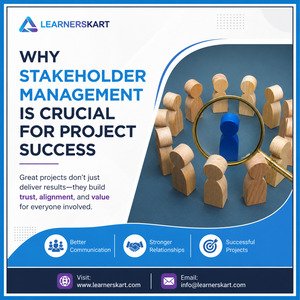
Why Stakeholder Management Is Crucial for Project Success?
-
May 5, 2026
Every project has deadlines, budgets, and deliverables—but the real driving force behind success is people.
No matter how strong your planning is, a project can quickly derail if stakeholders are misaligned, disengaged, or dissatisfied. That’s why stakeholder management isn’t just a process—it’s a critical success factor.
🎯 What Is Stakeholder Management?
Stakeholder management is the process of:
- Identifying everyone impacted by the project
- Understanding their needs and expectations
- Communicating effectively with them
- Actively engaging them throughout the project lifecycle
According to the Project Management Institute, successful projects depend heavily on how well stakeholders are engaged and managed—not just informed.
💡 Why Stakeholder Management Matters So Much
1. Aligns Expectations from the Start
One of the biggest reasons projects fail is misaligned expectations.
When stakeholders:
- Expect different outcomes
- Have unclear requirements
- Or aren’t involved early
👉 It leads to confusion, rework, and delays.
Effective stakeholder management ensures everyone is on the same page from day one.
2. Builds Trust and Strong Relationships
Projects are not just about tasks—they’re about relationships.
When stakeholders feel:
- Heard
- Involved
- Respected
They are more likely to:
- Support decisions
- Cooperate during challenges
- Stay engaged throughout the project
3. Prevents Conflicts and Last-Minute Surprises
Have you ever seen a project where everything looks fine… until suddenly someone says:
👉 “This is not what we wanted.”
That usually happens when stakeholders are not properly engaged.
Proactive communication helps:
- Identify concerns early
- Address issues before they escalate
- Avoid costly last-minute changes
4. Improves Decision-Making
Stakeholders bring valuable perspectives.
By involving the right people at the right time:
- Decisions become more informed
- Risks are identified earlier
- Solutions are more practical
5. Increases Project Success Rate
Projects with strong stakeholder engagement are:
- More likely to meet objectives
- More likely to stay within budget
- More likely to be accepted and supported
👉 In simple terms: Better engagement = Better outcomes
🧠 Common Stakeholder Challenges (and What They Mean)
Even experienced project managers face difficult stakeholders. Here are a few common situations:
- High influence, low engagement → Needs targeted communication
- Overly demanding stakeholders → Requires clear expectations
- Silent stakeholders → Needs proactive follow-ups
- Resistant stakeholders → Needs trust-building and involvement
Understanding these behaviors helps you respond effectively instead of reacting emotionally.
🛠️ Key Strategies for Effective Stakeholder Management
✔ Identify and Prioritize Stakeholders
Not all stakeholders have the same level of influence.
Use simple techniques like:
- Power vs Interest analysis
- Stakeholder mapping
✔ Tailor Your Communication
One-size-fits-all communication does not work.
Some stakeholders prefer:
- Detailed reports
- Quick summaries
- One-on-one discussions
👉 Adapt your style based on their needs.
✔ Engage Regularly (Not Just When There’s a Problem)
Don’t wait for issues to arise.
Consistent engagement helps:
- Build trust
- Keep everyone informed
- Reduce resistance
✔ Listen Actively
Communication is not just about speaking—it’s about listening.
Make sure you:
- Understand concerns
- Acknowledge feedback
- Act where necessary
✔ Be Transparent and Honest
Even when things go wrong:
- Share updates clearly
- Avoid hiding issues
- Focus on solutions
Transparency builds long-term credibility.
❌ Common Mistakes to Avoid
- Ignoring key stakeholders
- Communicating too late
- Sending generic updates to everyone
- Focusing only on tasks, not people
- Not adapting communication style
These mistakes can slowly damage trust—and ultimately impact project success.
🚀 Real-World Insight
In many real projects, failure doesn’t happen because of poor planning—it happens because:
👉 Stakeholders were not aligned
👉 Communication was ineffective
👉 Expectations were not managed
That’s why successful project managers focus just as much on people as they do on processes.
📈 Final Takeaway
Stakeholder management is not a one-time activity—it’s an ongoing effort that continues throughout the project lifecycle.
If you remember one thing, let it be this:
👉 “Projects succeed when stakeholders are engaged, aligned, and satisfied.”
🎓 Want to Build Strong Project Management Skills?
If you’re looking to strengthen your project management knowledge and learn practical, real-world strategies, structured training can make a big difference.
At Learnerskart, we help professionals:
- Understand project management concepts in a practical way
- Improve stakeholder communication and leadership skills
- Gain confidence to handle real-world project challenges
📞 Contact Learnerskart
🌐 Visit: www.learnerskart.com | #x1f4e7; Email: info@learnerskart.com
✔️ Follow us for PM tips amp; career insights: https://lnkd.in/gYB4Dw4K
Take the next step in your project management journey and build skills that truly drive success #x1f680;
Tags:
importance of stakeholder managementmanaging stakeholders effectivelyproject leadership skillsProject Management Best Practicesproject success strategiesstakeholder communicationstakeholder engagementStakeholder Managementstakeholder management in project managementstakeholder relationship management
You May Also Like

-
Jun 3, 2026
In today’s fast-paced and highly competitive business environment, organizations are constantly striving to achieve strategic goals, improve operational efficiency, and...
-
Jun 2, 2026
In many organizations, project management is often associated with schedules, trackers, dashboards, status reports, and governance meetings. While these tools...
-
May 8, 2026
Managing projects today is more complicated than ever. Project managers are expected to track schedules, budgets, resources, risks, issues, deadlines,...
-
May 7, 2026
Breaking into project management—or leveling up within it—doesn’t just depend on theory. It’s about how effectively you plan, collaborate, track,...
Sign up to receive our latest updates
Company
Support
Service Offerings
Special Offers
Get in touch
India
Call us directly?
+91-984-459-1589
Address
Learnerskart Solutions Pvt Ltd
4th floor, No: 207/189, 9th Main Rd, 6th Sector,
HSR Layout, Bengaluru, Karnataka 560102
info@learnerskart.com
USA
Call us directly?
+1 (307)-998-3816
Address
Learnerskart Americas LLC
30 N Gould St Ste R
Sheridan, WY 82801
info@learnerskart.com
Quick Contact
Trending Categories
Disclaimer
“PMI®”, “PMBOK®”, “PMP®”, “CAPM®” and “PMI-ACP®” are registered marks of the Project Management Institute, Inc.
ITIL® and PRINCE2® are registered trade marks of AXELOS Limited, used under permission of AXELOS Limited. All rights reserved.
“CSM”, “CST” are Registered Trade Marks of The Scrum Alliance, USA.
