
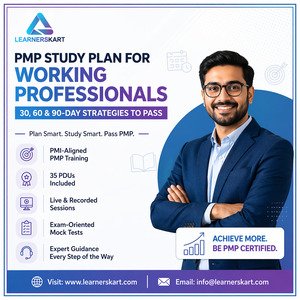
PMP Study Plan for Working Professionals: 30, 60 & 90-Day Strategies to Pass
-
April 22, 2026
You’ve got a full-time job, deadlines that don’t wait, and a life outside work. And somewhere in between, you’ve decided to crack the PMP. That’s not unrealistic—it just needs a plan that respects your reality.
Most PMP failures don’t happen because the exam is “too hard.” They happen because people try to study like full-time students while living a full-time professional life. This guide fixes that.
Aligned with the standards of the Project Management Institute, here’s a practical way to prepare—whether you have 90, 60, or 30 days.
First, a Reality Check (No Sugarcoating)
- PMP prep typically requires 150–200 hours
- The exam is scenario-based, not memory-based
- Around 50% of the questions involve Agile or hybrid approaches
If your plan doesn’t reflect this, it’s not a plan—it’s wishful thinking.
Choose Your Timeline (Be Honest Here)
- 90 Days → Best for beginners or busy professionals
- 60 Days → Good if you can study consistently
- 30 Days → Only if you already have strong PM experience + prior exposure
Don’t pick the shortest timeline. Pick the one you can actually follow.
🟢 90-Day PMP Study Plan (Most Realistic)
Who this is for:
- Working professionals with limited daily time
- First-time PMP candidates
- People starting from scratch
Weekly Time Commitment:
- Weekdays: 1–1.5 hours/day
- Weekends: 2–3 hours/day
📅 Month 1: Build Your Foundation
Focus on understanding—not memorizing.
- Study concepts from the PMBOK Guide Seventh Edition
- Learn key domains: People, Process, Business Environment
- Start with Agile basics from the Agile Practice Guide
- Do 10–20 practice questions daily
👉 Goal: Get comfortable with PMP language and mindset
📅 Month 2: Practice + Application
Now shift from learning to applying.
- Increase to 30–50 questions daily
- Start analyzing why answers are correct or wrong
- Focus heavily on:
- Agile scenarios
- Hybrid project questions
- Take 1 mock test per week
👉 Goal: Build decision-making ability
📅 Month 3: Exam Mode
This is where most people either pass or fail.
- Take 2 full-length mocks per week
- Review mistakes deeply (this is where real learning happens)
- Revise weak areas only—not everything again
👉 Goal: Improve accuracy + speed
🟡 60-Day PMP Study Plan (Accelerated)
Who this is for:
- Professionals with some PM experience
- Those who can commit 2–3 hours daily
📅 First 30 Days:
- Cover all concepts quickly
- Study both PMBOK + Agile together
- Practice 30+ questions daily
📅 Next 30 Days:
- Focus on mocks (2–3 per week)
- Deep error analysis
- Strengthen weak areas
👉 This plan works—but only if you stay consistent.
🔴 30-Day PMP Study Plan (Crash Strategy)
Let’s be clear—this is not for beginners.
Who this is for:
- Experienced project managers
- Candidates who already completed training (35 PDUs)
- People doing revision—not first-time learning
Daily Commitment:
- 5–6 hours/day minimum
Weekly Breakdown:
Week 1:
- Rapid revision of concepts
- Focus on Agile + key frameworks
Week 2:
- 50–100 practice questions daily
- Identify weak areas
Week 3:
- Full-length mock tests (every alternate day)
- Analyze mistakes deeply
Week 4:
- Final revision
- Light practice
- Focus on mindset and exam strategy
👉 If you’re starting from zero, don’t choose this plan.
📚 What You Actually Need to Study
Keep it simple. Don’t overload yourself.
- PMBOK Guide Seventh Edition → Understand concepts
- Agile Practice Guide → Critical for exam
- A structured PMP training (for PDUs + clarity)
- Mock tests + question banks
🚫 Common Mistakes That Kill Your Chances
1. Reading everything like a textbook
PMP is not about memorization. It’s about decision-making.
2. Resource overload
Too many courses = confusion.
Stick to one structured source.
3. Ignoring Agile
Half the exam is Agile/hybrid. Skipping this = guaranteed struggle.
4. Not practicing enough questions
You don’t fail PMP because you didn’t study.
You fail because you didn’t practice thinking like PMP.
5. Delaying the exam
If you keep postponing, your preparation never feels “enough.”
Book the exam. Pressure creates focus.
🧠 The PMP Mindset (This Changes Everything)
Most questions won’t ask: #x1f449; “What is the definition?”
They will ask: #x1f449; “What should the project manager do next?”
You need to think like:
- A servant leader
- A problem solver
- A stakeholder-focused decision maker
🎯 Final Thoughts
PMP isn’t about intelligence or experience alone. It’s about structure, consistency, and the right strategy.
- If you’re busy → choose 90 days
- If you’re consistent → choose 60 days
- If you’re experienced → choose 30 days
But whichever you choose—commit to it.
Because the difference between people who pass and those who don’t is simple:
👉 One had a system.
👉 The other had intentions.
If you follow a realistic plan and stay consistent, PMP is absolutely achievable—even with a full-time job.
🚀 Need Help with Your PMP Preparation?
If you’re serious about clearing PMP on your first attempt, having the right guidance can save you months of confusion and rework.
At Learnerskart, we help working professionals prepare smarter—not harder.
🎯 What You Get:
- PMI-aligned PMP training program
- 35 PDUs (mandatory for exam eligibility)
- Real exam-based mock tests amp; question banks
- Step-by-step guidance until you pass
- Support designed specifically for busy professionals
📩 Contact Details:
🌐 Visit: www.learnerskart.com | #x1f4e7; Email: info@learnerskart.com
✔️ Follow us for PM tips amp; career insights: https://lnkd.in/gYB4Dw4K
Tags:
You May Also Like

-
Jun 3, 2026
In today’s fast-paced and highly competitive business environment, organizations are constantly striving to achieve strategic goals, improve operational efficiency, and...
-
Jun 2, 2026
In many organizations, project management is often associated with schedules, trackers, dashboards, status reports, and governance meetings. While these tools...
-
May 8, 2026
Managing projects today is more complicated than ever. Project managers are expected to track schedules, budgets, resources, risks, issues, deadlines,...
-
May 7, 2026
Breaking into project management—or leveling up within it—doesn’t just depend on theory. It’s about how effectively you plan, collaborate, track,...
Sign up to receive our latest updates
Company
Support
Service Offerings
Special Offers
Get in touch
India
Call us directly?
+91-984-459-1589
Address
Learnerskart Solutions Pvt Ltd
4th floor, No: 207/189, 9th Main Rd, 6th Sector,
HSR Layout, Bengaluru, Karnataka 560102
info@learnerskart.com
USA
Call us directly?
+1 (307)-998-3816
Address
Learnerskart Americas LLC
30 N Gould St Ste R
Sheridan, WY 82801
info@learnerskart.com
Quick Contact
Trending Categories
Disclaimer
“PMI®”, “PMBOK®”, “PMP®”, “CAPM®” and “PMI-ACP®” are registered marks of the Project Management Institute, Inc.
ITIL® and PRINCE2® are registered trade marks of AXELOS Limited, used under permission of AXELOS Limited. All rights reserved.
“CSM”, “CST” are Registered Trade Marks of The Scrum Alliance, USA.
