
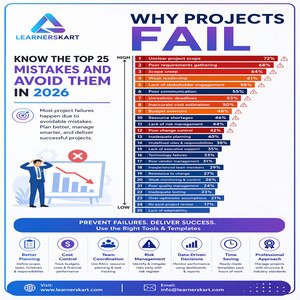
Why Projects Fail: Top 25 Mistakes and How to Avoid Them in 2026
-
April 21, 2026
Projects don’t fail because teams lack effort—they fail because of predictable and preventable mistakes. Whether you’re managing a small initiative or a large enterprise program, understanding the root causes of failure can dramatically improve your success rate.
According to globally accepted standards from Project Management Institute, most project failures occur due to gaps in planning, communication, leadership, and control, not technical complexity.
In this comprehensive guide, we’ll explore the top 25 reasons why projects fail in 2026—and exactly how to avoid them.
🚨 Top 25 Reasons Why Projects Fail (and How to Fix Them)
1. Unclear Project Scope (72%)
Problem: Ambiguous scope leads to confusion and rework
Solution: Define a detailed scope statement and create a Work Breakdown Structure (WBS)
2. Poor Requirements Gathering (68%)
Problem: Missing or misunderstood requirements
Solution: Conduct workshops, interviews, and validate with stakeholders
3. Scope Creep (64%)
Problem: Uncontrolled changes expand project boundaries
Solution: Implement a formal change control process
4. Weak Leadership (61%)
Problem: Lack of direction slows progress
Solution: Assign experienced project managers with strong leadership skills
5. Lack of Stakeholder Engagement (58%)
Problem: Misalignment and low involvement
Solution: Maintain regular communication and engagement plans
6. Poor Communication (55%)
Problem: Miscommunication causes delays and errors
Solution: Create a structured communication plan
7. Unrealistic Deadlines (53%)
Problem: Over-optimistic timelines
Solution: Use realistic scheduling with buffers
8. Inaccurate Cost Estimation (50%)
Problem: Budget planning errors
Solution: Apply bottom-up and historical estimation techniques
9. Budget Overruns (48%)
Problem: Costs exceed planned budgets
Solution: Track using Earned Value Management (EVM)
10. Resource Shortages (46%)
Problem: Lack of skilled team members
Solution: Plan resource allocation early
11. Lack of Risk Management (44%)
Problem: Risks ignored until too late
Solution: Maintain a risk register and mitigation plan
12. Poor Change Control (42%)
Problem: Unmanaged changes disrupt progress
Solution: Establish approval workflows
13. Inadequate Planning (40%)
Problem: Weak planning leads to execution failure
Solution: Develop a comprehensive project plan
14. Undefined Roles amp; Responsibilities (38%)
Problem: Team confusion
Solution: Use a RACI matrix
15. Lack of Executive Support (35%)
Problem: No top management backing
Solution: Secure sponsorship early
16. Technology Failures (33%)
Problem: Tools and systems fail
Solution: Use reliable tools with backup plans
17. Poor Vendor Management (31%)
Problem: External dependencies fail
Solution: Define SLAs and monitor vendor performance
18. Inexperienced Team Members (29%)
Problem: Skill gaps affect delivery
Solution: Provide training and mentoring
19. Resistance to Change (27%)
Problem: Stakeholders resist new processes
Solution: Apply change management strategies
20. Weak Monitoring amp; Control (26%)
Problem: Issues go unnoticed
Solution: Use dashboards and KPIs
21. Poor Quality Management (24%)
Problem: Deliverables don’t meet standards
Solution: Implement QA/QC processes
22. Inadequate Testing (23%)
Problem: Errors discovered late
Solution: Conduct continuous testing
23. Over-Optimistic Assumptions (21%)
Problem: Unrealistic expectations
Solution: Validate assumptions with data
24. No Post-Project Review (17%)
Problem: No lessons learned
Solution: Conduct retrospectives
25. Lack of Adaptability
Problem: Inability to respond to change
Solution: Adopt Agile or hybrid approaches
🧰 Simplify Project Success with Ready-to-Use Templates
Understanding failure is important—but preventing it requires the right tools.
Managing projects becomes much easier when you follow structured practices from Project Management and use proven templates.
📊 Project Management Plan – Simplify Planning, Tracking amp; Execution
These Project Management Plan Templates in Excel provide a complete framework to plan, organize, monitor, and control every aspect of your project.
Included templates:
- Project Charter
- Work Breakdown Structure (WBS)
- Task Tracker
- Kanban Board
- Risk Register
- Budget Tracker amp; Cost Analysis
- Stakeholder Analysis
- Project Dashboard
Instead of creating documents from scratch, these ready-to-use templates help you:
- Structure your workflow
- Manage resources efficiently
- Track progress in real time
- Deliver projects successfully
💡 Key Benefits
✅ Better Planning – Clearly define scope, timelines, and responsibilities
✅ Improved Cost Control – Track budgets and financial performance
✅ Stronger Team Coordination – Use RACI, resource planning, and task tracking
✅ Effective Risk Management – Identify and mitigate risks early
✅ Data-Driven Decisions – Monitor performance with dashboards
✅ Time Saving – Reduce manual work with ready templates
✅ Professional Execution – Follow structured, industry-standard practices
🎯 Key Takeaways
- Most project failures are avoidable with proper planning and control
- Communication and stakeholder engagement are critical for success
- Structured tools and templates can eliminate common mistakes
- Continuous monitoring ensures projects stay on track
🚀 Final Thoughts
In 2026, successful project management is not just about meeting deadlines—it’s about delivering value, quality, and stakeholder satisfaction.
By understanding these common failure points and applying the right strategies, you can turn challenges into opportunities and consistently deliver successful projects.
🎓 Take Your Project Management Skills to the Next Level
If you want to master real-world project management and avoid these common mistakes, professional training can make a big difference.
Learnerskart.com offers industry-recognized certification training programs designed to help you succeed in your career.
🌐 Visit: www.learnerskart.com | #x1f4e7; Email: info@learnerskart.com
✔️ Follow us for PM tips amp; career insights: https://lnkd.in/gYB4Dw4K
Start your journey toward becoming a confident and successful project manager today #x1f680;
Tags:
Agile Project Managementhow to avoid project failureLearnersKart PMPpmp conceptspoor project planningproject communication problemsproject cost overrunsproject execution strategiesproject failure reasonsProject Management Best Practicesproject management blogproject management mistakesproject management templatesProject Manager Tipsproject planning toolsproject risk managementproject success strategiesscope creep issueswhy projects fail
You May Also Like

-
Jun 3, 2026
In today’s fast-paced and highly competitive business environment, organizations are constantly striving to achieve strategic goals, improve operational efficiency, and...
-
Jun 2, 2026
In many organizations, project management is often associated with schedules, trackers, dashboards, status reports, and governance meetings. While these tools...
-
May 8, 2026
Managing projects today is more complicated than ever. Project managers are expected to track schedules, budgets, resources, risks, issues, deadlines,...
-
May 7, 2026
Breaking into project management—or leveling up within it—doesn’t just depend on theory. It’s about how effectively you plan, collaborate, track,...
Sign up to receive our latest updates
Company
Support
Service Offerings
Special Offers
Get in touch
India
Call us directly?
+91-984-459-1589
Address
Learnerskart Solutions Pvt Ltd
4th floor, No: 207/189, 9th Main Rd, 6th Sector,
HSR Layout, Bengaluru, Karnataka 560102
info@learnerskart.com
USA
Call us directly?
+1 (307)-998-3816
Address
Learnerskart Americas LLC
30 N Gould St Ste R
Sheridan, WY 82801
info@learnerskart.com
Quick Contact
Trending Categories
Disclaimer
“PMI®”, “PMBOK®”, “PMP®”, “CAPM®” and “PMI-ACP®” are registered marks of the Project Management Institute, Inc.
ITIL® and PRINCE2® are registered trade marks of AXELOS Limited, used under permission of AXELOS Limited. All rights reserved.
“CSM”, “CST” are Registered Trade Marks of The Scrum Alliance, USA.
