
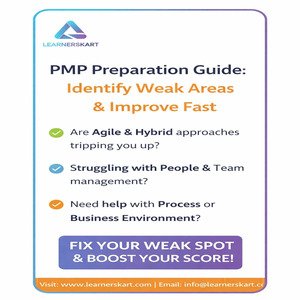
PMP Preparation Guide: Identify Weak Areas & Improve Fast
-
April 15, 2026
Preparing for the PMP exam can feel confusing and overwhelming—especially when you’re putting in the effort but not seeing the results you expect.
The truth is simple:
👉 Most candidates don’t fail because they lack knowledge
👉 They fail because they don’t know their weak areas
The PMP certification by the Project Management Institute is designed to test how well you apply concepts in real-world scenarios—not just how much you remember.
If you want to pass faster and with confidence, the key is to identify your weak spots and fix them strategically.
Let’s walk through how to do that.
📊 Understanding the PMP Exam Structure
Before improving, you need clarity on what the exam actually tests.
The PMP exam is divided into three core domains:
1. People (42%)
This domain focuses on:
- Leadership and team management
- Conflict resolution
- Communication with stakeholders
- Building high-performing teams
👉 You are tested on how you handle real-life team situations
2. Process (50%)
This is the largest and most technical domain.
It includes:
- Planning and execution
- Scope, schedule, cost, and quality
- Risk and change management
- Project lifecycle understanding
👉 This domain evaluates your project management knowledge and decision-making
3. Business Environment (8%)
This domain covers:
- Organizational strategy
- Compliance and governance
- Delivering business value
👉 Even though smaller, it can be scoring or losing edge
4. Agile amp; Hybrid (Across All Domains)
Agile is integrated into all three domains.
You’ll encounter:
- Scrum practices
- Hybrid project approaches
- Adaptive planning and delivery
👉 Many candidates struggle here due to mindset differences
🚨 Why Most PMP Aspirants Struggle
Even experienced professionals face challenges. Here’s why:
❌ 1. Focusing only on theory
Reading guides without applying concepts leads to confusion during the exam.
❌ 2. Ignoring Agile mindset
Traditional project managers often struggle to adapt to Agile thinking.
❌ 3. Lack of practice
PMP questions are scenario-based, not direct.
❌ 4. No clear strategy
Studying everything equally wastes time and energy.
🔍 Step 1: Identify Your Weak Area
Start with a simple question:
Which PMP exam area do you find most challenging?
- Agile amp; Hybrid approaches
- People (Leadership amp; Team)
- Process (Traditional PM)
- Business Environment
👉 Your answer determines your preparation strategy.
🎯 Step 2: Fix Your Weak Area (Targeted Approach)
🟢 If Agile amp; Hybrid is your weak area
Common issues:
- Thinking in waterfall approach
- Confusion in Agile roles and practices
How to improve:
- Understand servant leadership mindset
- Focus on collaboration and flexibility
- Learn Scrum roles (Product Owner, Scrum Master, Team)
- Practice Agile-based scenario questions daily
👉 Key tip: Think “team-first,” not “process-first”
🔵 If People (Leadership) is your weak area
Common issues:
- Difficulty in situational judgment questions
- Confusion in handling conflicts
How to improve:
- Learn conflict resolution techniques
- Understand leadership styles
- Focus on communication strategies
- Practice stakeholder management scenarios
👉 Key tip: Choose answers that are proactive, collaborative, and empathetic
🟡 If Process is your weak area
Common issues:
- Too many concepts and processes
- Difficulty remembering ITTOs
How to improve:
- Focus on understanding the flow of processes
- Learn how processes connect
- Practice questions on:
- Risk management
- Change control
- Scope management
👉 Key tip: Don’t memorize—understand how projects actually work
🔴 If Business Environment is your weak area
Common issues:
- Ignoring this domain due to low weight
- Lack of clarity on business concepts
How to improve:
- Understand organizational impact
- Learn compliance and governance basics
- Focus on value delivery and benefits realization
👉 Key tip: This is a high-scoring, low-effort area
📈 Step 3: Build a Smart Study Plan
To improve quickly, follow this proven strategy:
✅ 1. Take a full-length mock test
Identify your weakest domain immediately
✅ 2. Focus 60% of your time on weak areas
Don’t over-study what you already know
✅ 3. Practice scenario-based questions daily
This is the most important step
✅ 4. Review your mistakes
Understand why you got answers wrong
✅ 5. Revise mindset, not just concepts
Especially for Agile and People domains
💡 Pro Tips to Pass PMP Faster
- Think like a project manager, not a student
- Always choose the best next action, not just a correct one
- Avoid reactive answers—be proactive
- Prioritize communication and collaboration
- Focus on real-world application
🚀 Final Thoughts
Struggling with PMP doesn’t mean you’re not capable.
It simply means: #x1f449; You need a smarter approach
Once you identify your weak areas and work on them strategically, your confidence—and your score—will improve significantly.
💬 Let’s Make It Interactive
Which PMP area is your biggest challenge?
- Agile amp; Hybrid
- People (Leadership amp; Team)
- Process
- Business Environment
Drop your answer—and get targeted tips to improve faster #x1f4c8;
🎯 Need Expert Guidance?
If you want:
- Structured PMP training
- Real exam-based mock tests
- Personalized performance analysis
👉 Learnerskart can help you prepare smarter and pass faster.
🌐 Visit: www.learnerskart.com | #x1f4e7; Email: info@learnerskart.com
✔️ Follow us for PM tips amp; career insights: https://lnkd.in/gYB4Dw4K
Tags:
best way to pass PMP exam first attempthow to identify weak areas in PMP examhow to pass PMP examPMP Agile questionsPMP Agile vs waterfall questions explainedPMP Business EnvironmentPMP exam domains explained with examplesPMP exam preparation IndiaPMP exam strategyPMP exam tipsPMP mock test tipsPMP People domainPMP PreparationPMP preparation strategy for working professionalsPMP Process domainPMP study planPMP weak areas
You May Also Like

-
Jun 3, 2026
In today’s fast-paced and highly competitive business environment, organizations are constantly striving to achieve strategic goals, improve operational efficiency, and...
-
Jun 2, 2026
In many organizations, project management is often associated with schedules, trackers, dashboards, status reports, and governance meetings. While these tools...
-
May 8, 2026
Managing projects today is more complicated than ever. Project managers are expected to track schedules, budgets, resources, risks, issues, deadlines,...
-
May 7, 2026
Breaking into project management—or leveling up within it—doesn’t just depend on theory. It’s about how effectively you plan, collaborate, track,...
Sign up to receive our latest updates
Company
Support
Service Offerings
Special Offers
Get in touch
India
Call us directly?
+91-984-459-1589
Address
Learnerskart Solutions Pvt Ltd
4th floor, No: 207/189, 9th Main Rd, 6th Sector,
HSR Layout, Bengaluru, Karnataka 560102
info@learnerskart.com
USA
Call us directly?
+1 (307)-998-3816
Address
Learnerskart Americas LLC
30 N Gould St Ste R
Sheridan, WY 82801
info@learnerskart.com
Quick Contact
Trending Categories
Disclaimer
“PMI®”, “PMBOK®”, “PMP®”, “CAPM®” and “PMI-ACP®” are registered marks of the Project Management Institute, Inc.
ITIL® and PRINCE2® are registered trade marks of AXELOS Limited, used under permission of AXELOS Limited. All rights reserved.
“CSM”, “CST” are Registered Trade Marks of The Scrum Alliance, USA.
