
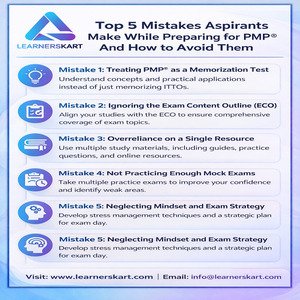
Top 5 Mistakes Aspirants Make While Preparing for PMP® and How to Avoid Them
-
April 3, 2026
Introduction
Every year, thousands of professionals begin their journey toward the PMP® certification with high hopes. However, many fail to clear the exam on their first attempt—not due to lack of effort, but because of avoidable mistakes.
The Project Management Professional (PMP®) certification, offered by the Project Management Institute, is globally recognized as a gold standard in project management. It validates your ability to lead projects, manage teams, and deliver business value.
To succeed, it’s not just about studying hard—it’s about studying smart. In this blog, we’ll explore the top 5 PMP exam preparation mistakes and how you can avoid them to improve your chances of success.
Mistake 1: Treating PMP® as a Memorization Test
Many aspirants assume that PMP® preparation is all about memorizing ITTOs (Inputs, Tools amp; Techniques, Outputs). However, the actual exam is heavily scenario-based.
You’ll encounter questions like:
“What should the project manager do next?”
In such cases, memorization alone won’t help.
How to Avoid It
Focus on understanding the “why” behind each concept.
Learn how processes connect and apply them to real-world scenarios. Think like a project manager rather than a student.
Mistake 2: Ignoring the Exam Content Outline (ECO)
Some candidates rely only on study materials without reviewing the official Exam Content Outline (ECO). This leads to major gaps, especially in:
- Agile methodologies
- Hybrid project approaches
- People and leadership skills
How to Avoid It
Align your preparation strictly with the ECO. Ensure balanced coverage across:
- People (42%)
- Process (50%)
- Business Environment (8%)
This ensures you’re preparing exactly what the exam tests.
Mistake 3: Overreliance on a Single Resource
Many aspirants depend on just one book or course. This limits exposure to different question patterns and interpretations.
How to Avoid It
Use multiple trusted resources such as:
- PMBOK® Guide
- Agile Practice Guide
- Mock exams and simulators
- Instructor-led training programs
A combination of resources builds deeper understanding and confidence.
Mistake 4: Not Practicing Enough Mock Exams
One of the biggest mistakes is underestimating the importance of mock tests. Without practice, candidates struggle with:
- Time management
- Exam stamina
- Question interpretation
How to Avoid It
- Take full-length timed mock exams
- Analyze every incorrect answer
- Identify weak areas and improve
Aim to consistently score 70–80% or higher before scheduling your actual exam.
Mistake 5: Neglecting Mindset and Exam Strategy
Even well-prepared candidates can fail due to poor exam strategy or anxiety. Lack of time management and panic can lead to avoidable errors.
How to Avoid It
- Practice time management (approx. 1 minute per question)
- Use elimination techniques
- Take short mental breaks during the exam
- Stay calm and focused
Remember, confidence and mindset are just as important as knowledge.
Quick Recap
- Don’t memorize—focus on understanding concepts
- Follow the ECO strictly
- Use multiple study resources
- Practice mock exams seriously
- Build a strong exam mindset
Conclusion
PMP® preparation is not about how much you study—it’s about how effectively you prepare.
By avoiding these common mistakes and adopting a structured approach, you can significantly increase your chances of passing the exam on your first attempt.
Earning the PMP® certification is more than just clearing an exam—it’s about developing the mindset of a successful project leader.
Need Expert Guidance for PMP® Preparation?
Learnerskart provides comprehensive PMP® training designed to help you succeed on your first attempt.
✔ Instructor-led training
✔ Real exam-based mock tests
✔ Updated content aligned with ECO
✔ Personalized guidance and support
🌐 Visit: www.learnerskart.com | #x1f4e7; Email: info@learnerskart.com
✔️ Follow us for PM tips amp; career insights: https://lnkd.in/gYB4Dw4K
Start your PMP® journey today with the right strategy and expert support.
Tags:
You May Also Like

-
Jun 3, 2026
In today’s fast-paced and highly competitive business environment, organizations are constantly striving to achieve strategic goals, improve operational efficiency, and...
-
Jun 2, 2026
In many organizations, project management is often associated with schedules, trackers, dashboards, status reports, and governance meetings. While these tools...
-
May 8, 2026
Managing projects today is more complicated than ever. Project managers are expected to track schedules, budgets, resources, risks, issues, deadlines,...
-
May 7, 2026
Breaking into project management—or leveling up within it—doesn’t just depend on theory. It’s about how effectively you plan, collaborate, track,...
Sign up to receive our latest updates
Company
Support
Service Offerings
Special Offers
Get in touch
India
Call us directly?
+91-984-459-1589
Address
Learnerskart Solutions Pvt Ltd
4th floor, No: 207/189, 9th Main Rd, 6th Sector,
HSR Layout, Bengaluru, Karnataka 560102
info@learnerskart.com
USA
Call us directly?
+1 (307)-998-3816
Address
Learnerskart Americas LLC
30 N Gould St Ste R
Sheridan, WY 82801
info@learnerskart.com
Quick Contact
Trending Categories
Disclaimer
“PMI®”, “PMBOK®”, “PMP®”, “CAPM®” and “PMI-ACP®” are registered marks of the Project Management Institute, Inc.
ITIL® and PRINCE2® are registered trade marks of AXELOS Limited, used under permission of AXELOS Limited. All rights reserved.
“CSM”, “CST” are Registered Trade Marks of The Scrum Alliance, USA.
